
 Facebook
 X
 Pinterest
 Copy Link
The Equity Advantage: Finding Opportunity in a Changing Market
Home prices are correcting, but a decade of appreciation continues to create opportunities for homeowners.
The real estate market is shifting, and while recent headlines have focused on declining home prices, there’s an important part of the story that deserves perspective: Homeowners have experienced substantial appreciation over the past decade, and much of that value remains intact. Even more so, homeowners who have owned their homes longer than 10 years are sitting on incredible amounts of equity.
Consider the numbers over the last 10 years. In 2016, from January–October, the average of the monthly median sales price for a single-family residential home was $540,000 in King County and $387,000 in Snohomish County. By 2026, prices from January-October climbed to $947,000 and $759,000, respectively. That’s approximately 75% growth in King County and 96% in Snohomish County over the past 10 years, even during the recent market correction.
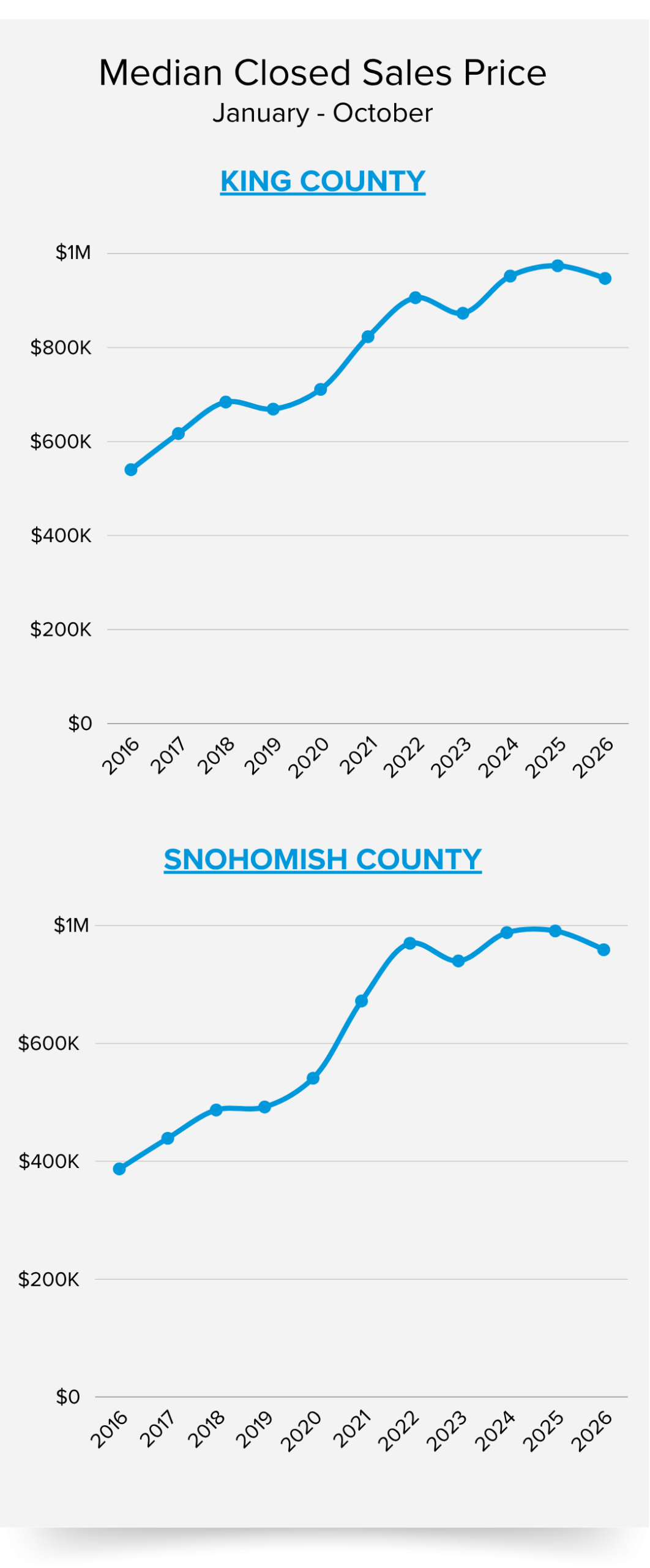
Yes, prices have softened over the past year. Comparing the January–October averages for 2025 over 2026, King County declined approximately 3%, while Snohomish County declined approximately 4%. Further, 2026 has proven to be a year of correction, with the median price down 7% in King County from October 2025 over October 2026 and down 6% in Snohomish County. This is largely due to interest rates rising over 1 point since April 2026.
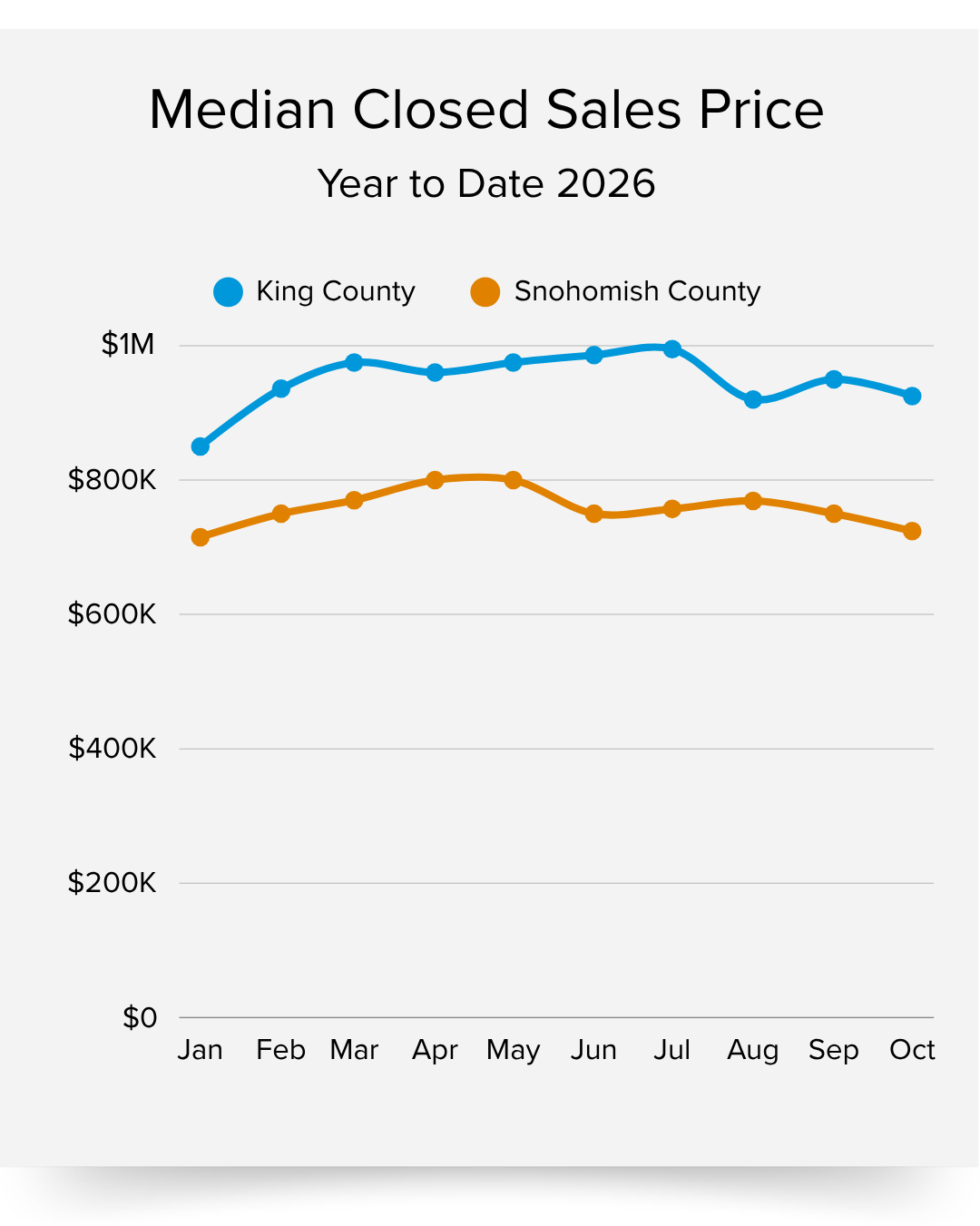
With so much appreciation front-loaded into the current decade starting in 2020, the recent correction is leveling out the rapid growth we experienced, which was unsustainable, especially given the rise in interest rates. Viewed through a longer-term lens, today’s market represents a meaningful adjustment following years of exceptional growth, rather than a complete reversal of those gains.
For many longtime homeowners, substantial equity remains, creating opportunities to make their next move. According to the National Association of Realtors (NAR), the average amount of time a home seller has owned their home is 12 years. Conversely, if you have only owned your home for a few years, selling now could be a challenge to regain what you paid for it, as the cycle is not currently in favor of a quick turnaround, nor is that the historical norm, given real estate is intended to be a long-term hold investment.
The Bigger Picture: Real Estate Is a Long-Term Investment
Historically, U.S. home prices have appreciated at an annualized rate of approximately 4.5% over the past 30 years according to the Federal Housing Finance Agency (FHFA), despite multiple economic downturns, changing interest rates, and housing market corrections. Closer to home, the annualized increase in the January–October average median sales price from 2016 through 2026 was approximately 5.8% in King County and 7.0% in Snohomish County, even with the recent correction.
These numbers reinforce an important principle: Real estate markets move through cycles, but long-term homeownership has historically been a powerful tool for building wealth. While appreciation is never guaranteed and individual property values vary, many longtime homeowners have accumulated substantial equity that can help support their next chapter. Also, despite the correction we are experiencing, there have been over 22,000 closed sales in King and Snohomish counties year-to-date.
Life Changes. Housing Needs Change.
People rarely make housing decisions based solely on interest rates or market conditions. Timing the market is rarely the reason. Life continues to evolve, and our housing needs evolve with it. Some of the most common reasons homeowners decide to sell include:
- Downsizing, retirement, or multi-generational living: Seeking a smaller home, less maintenance, age-in-place floor plans, assisted-living needs, or greater freedom and flexibility.
- Growing or changing families: Needing additional bedrooms, more functional space, or a home that better accommodates a growing household.
- Relocation: Moving for career opportunities, retirement, family proximity, or a different lifestyle.
- Lifestyle changes: Wanting a different neighborhood or school district, improved amenities, a shorter commute, or a home that better supports changing priorities.
- Financial considerations: Accessing accumulated equity, reducing housing expenses, or reallocating resources toward other financial goals.
- Major life transitions: Marriage, divorce, becoming an empty nester, or changes in health and family responsibilities.
Regardless of market conditions, these life events continue to drive real estate decisions. And for homeowners who have built significant equity, today’s market may offer more flexibility than they realize. Hence, there have been over 22,000 closed sales year-to-date in both counties.
A Unique Opportunity for Move-Up Buyers
One of the more interesting opportunities in today’s market may be for homeowners looking to move into a larger home, a more desirable neighborhood, or a property that better fits their lifestyle.
While selling prices may be lower than a year ago, the home you’re hoping to purchase may also be more negotiable. Increased inventory means more choices, less competition, and greater opportunities to negotiate on price, inspections, closing costs, or even interest rate buydowns.
Consider this example:
Imagine your current home was valued at $900,000 and the home you wanted to purchase was priced at $1,300,000.
If both properties experienced a hypothetical 7% price correction:
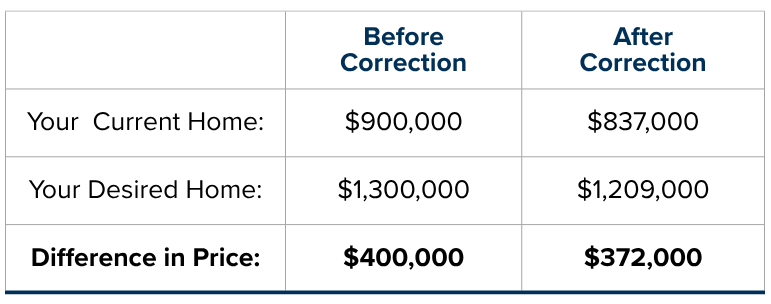
That’s a $28,000 reduction in the price gap between the two homes. While your existing home’s value has adjusted, the higher-priced home has experienced a larger dollar reduction, potentially making that next move more attainable. Add on a possible rate buy-down, and affordability improves further and the basis for future equity growth on a higher priced home helps build more wealth.
Of course, mortgage rates, monthly payments, available equity, and transaction costs all factor into the equation. This illustrates why a price correction doesn’t necessarily mean homeowners should put their plans on hold. In fact, we are seeing many buyers negotiate credits to help buy down their interest rate, resulting in monthly payments that are attainable. It’s important to not take the market only at face value and understand the opportunities that can be created through thoughtful negotiations and financial planning.
Perspective Creates Opportunity
Real estate has always been a long-term investment, and markets naturally experience periods of growth, adjustment, and stabilization. What matters most isn’t trying to perfectly time the market. It’s understanding how your equity, financial position, and housing needs align with today’s opportunities. Whether you’re considering moving up, downsizing, relocating, or simply curious about your home’s current value, having accurate information is the first step toward making a confident decision.
The market has changed. Your opportunities may have changed with it.
If you’ve been thinking about making a move, let’s look at your home’s current value, the equity you’ve built, and what today’s market could make possible for your next chapter.
The Shifting Market Advantage: Leveraging Seller Credits for Lower Monthly Payments

We’ve all read the headlines and know interest rates and inventory are up. In fact, rates are up by 1% from a year ago, and inventory is up year-to-date (YTD) 2026 over 2025 in King and Snohomish counties by 39%. These two factors have led to more price and credit negotiations for buyers and further opportunity to do inspections and due diligence. Many sellers are sitting on large amounts of equity, allowing for negotiations to complete a sale and meet the current market conditions, resulting in a great return. Buyers are enjoying added selection and more time to make big decisions. This is what happens in a more neutral market compared to the intense seller’s market we recently experienced.
The news that hasn’t clearly come to the forefront is how negotiations are playing out to create sales. My office tracks the detailed contract data metrics for our pending sales, which highlights terms such as financing type, down payment amounts, inspection concessions, and seller-paid buyer credits, to name a few. Gathering these insights is crucial to help us understand how transactions are being put together to create win-wins for both buyers and sellers. In our most recent data pull, 38% of our pending transactions had a seller-paid buyer credit, averaging $13,000.
Seller-paid buyer credits can be used to offset the money required for out-of-pocket closing costs. Putting more liquid cash in the hands of the buyer to freshen up or care for their new home, or keep a nest egg. It can also be used to buy down the buyer’s interest rate, in turn lowering their monthly payment and helping with affordability. There are different types of buydowns: a permanent buydown or a variable buy-down such as a 2-1 buydown.
A permanent buydown requires about 3% of the purchase price to buy the rate down by a point for the 30-year term of the loan. This 3% differential is close to the average List-to-Sale-Price Ratio (LP/SP%) of 98% on closed sales in King and Snohomish counties for Single-Family Residential (SFR) Homes month-to-date (MTD) in October 2026. The latest LP/SP% shows that a negotiation of this sort is not out of line with the trends. Using the example of an $800,000 purchase price, a 3% credit would be $24,000.
A good rule of thumb to remember is that every 1-point in rate equals 10% in buying power. For example, the current rate (as of 10/27/26) is 7.32%, and if you are qualified for a home at $800,000, if the rate went down by 1 point to 6.32%, you could now afford $880,000 and have a very similar payment. A more strategic way to look at this is simply the monthly payment itself. An $800,000 purchase with 20% down with a 6.32% interest rate would save a buyer $427 a month on their principal and interest (P&I) payment vs. the payment at 7.32%. Also worth noting, you don’t need 20% down to buy a house. Down payments can vary up or down, and the 20% down is for illustrative purposes only.
A permanent buy-down is a useful tool, and so is a temporary buy-down. The typical homeowner owns their property for 11 years before selling, according to the National Association of REALTORS®. While mortgage rates will fluctuate during that time, buyers today may have an opportunity to negotiate seller concessions that lower their initial housing costs. A seller-paid 2-1 buy-down can provide meaningful payment relief during the first two years, with the possibility of refinancing later if market conditions become favorable. It is actually one of the most powerful tools in today’s market. It costs far less than a permanent buy-down and resets the payments considerably for the first two years of the loan.
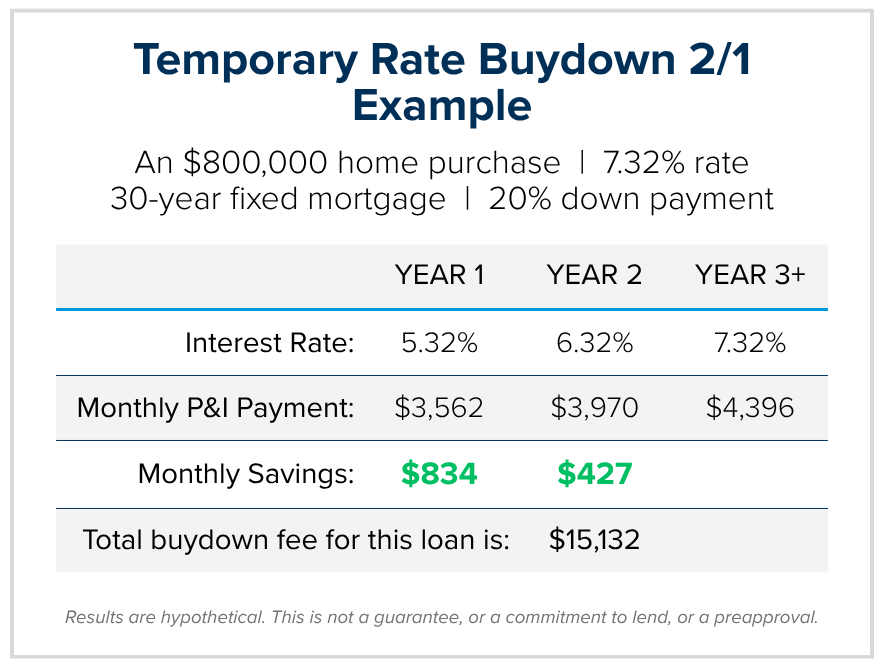
Here is an example: let’s say you are shopping for a house and have the same $800,000 budget and a 20% down payment with today’s rate of 7.32%. The monthly P&I payment at 7.32% would be $4,396. You could do a 2-1 buy-down (2 points lower in year one and 1 point lower in year two), which would have your payment in year one be based on an interest rate of 5.32% with a monthly P&I payment of $3,562 — a savings of $834 a month. For year two, the monthly P&I would be based on 6.32%, resulting in a monthly payment of $3,970, a $427 savings per month. The total savings in monthly payments with the 2-1 buy-down over the two years would be $15,132.
The roughly $15,000 in monthly payment savings is paid upfront at closing and, in some cases, paid by the seller via a seller-paid buyer credit that is negotiated. The buyer still needs to qualify based on the 7.32% interest rate, as the payments will convert to the payment based on the 7.32% in year three moving forward. Additionally, the home needs to appraise at the agreed-to purchase price with the credit baked into the contract. If during that two-year period the home buyer witnesses lower rates that they would be willing to refinance to in order to permanently fix their rate, they could do so. A bonus is that if the entire $15,000 credit has not been used yet, in some cases those funds can be applied towards the refinance costs.
This strategy has been effective in helping buyers secure a monthly payment that is more affordable so they can make a move now based on life’s needs and wants. It can help a renter become a homeowner, secure a move-up home for a growing family, or fuel a relocation due to life changes. With longer market times and increased inventory, we are finding that some home sellers are likely to assist with a credit for a 2-1 buy-down or the larger 3% credit to accommodate a lower payment for 30 years. The temporary assistance in reducing the payment for 1 to 2 years with the 2-1 buy-down is a viable tool for both the buyer and seller to create a win-win.
After several years of tight inventory, rapid price growth, and fewer negotiations, this is a welcome tool to assist home buyers with affordability and for sellers to meet the current market conditions to make a sale. This requires nuance and keen analysis by the listing broker, buyer broker, and a trusted lender, as the appraisal needs to line up with the purchase price for the credit to work. Some homes are still selling quickly without much negotiation based on the home’s condition, presentation, and accurate pricing. Many more homes are being sold with credits baked into the contracts to assist with affordability given the pressure of higher rates. That is why we track these contract metrics, so we can bring the latest information to both our buyers and sellers so they are equipped to make informed decisions.
If you are curious about how this shifting market aligns with your housing goals, please reach out. For buyers, connecting you with a skilled lender who can outline different options that fall within your current and long-term budget matters. For sellers, leading with the most current market data and helping prepare your home for market matters more than ever. I am happy to dig into your goals, apply the data, and supply you with useful tools to help you obtain the housing that is the best fit for your life according to your budget and financial picture.
QUARTERLY REPORTS Q3 2026

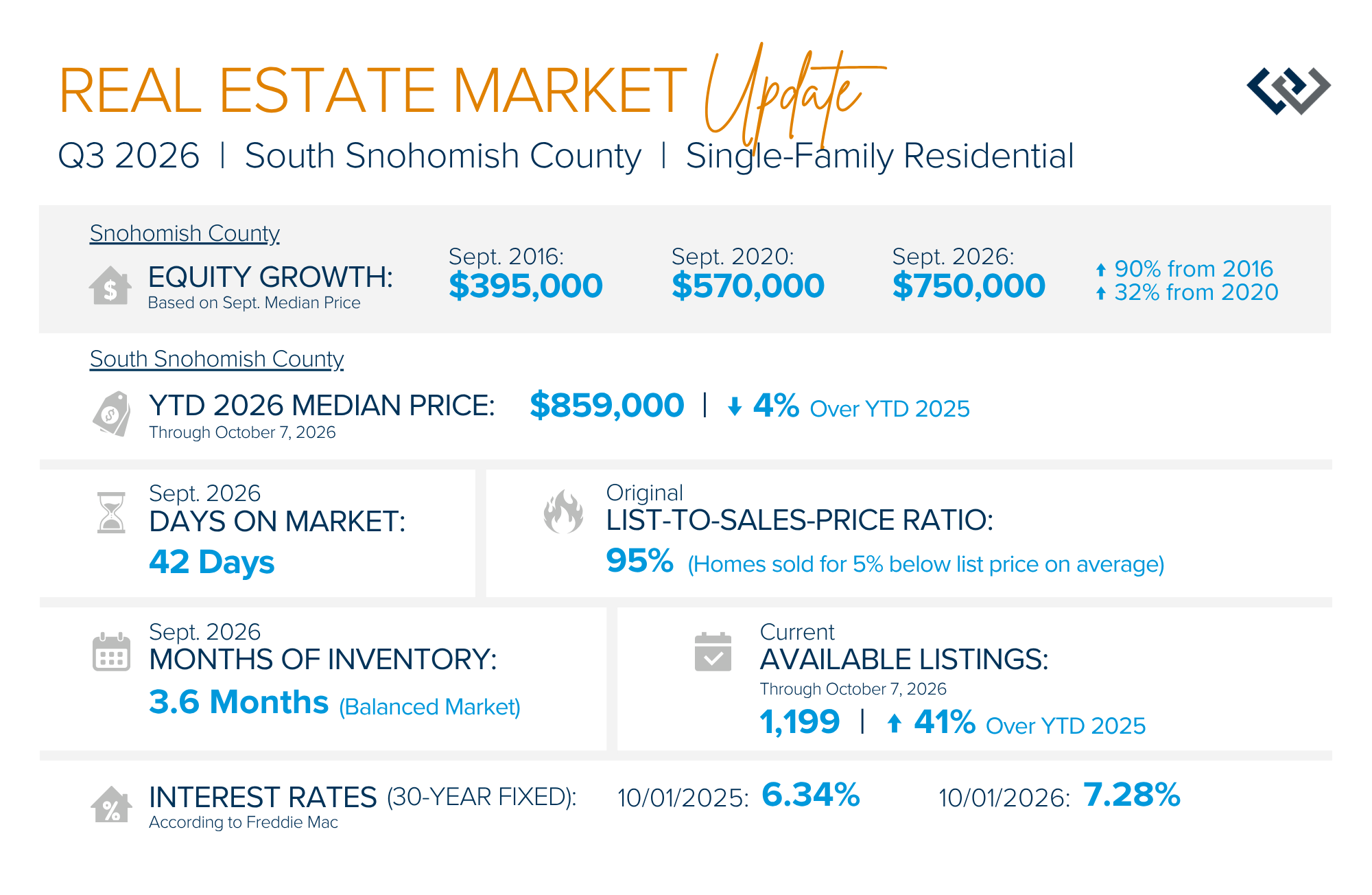
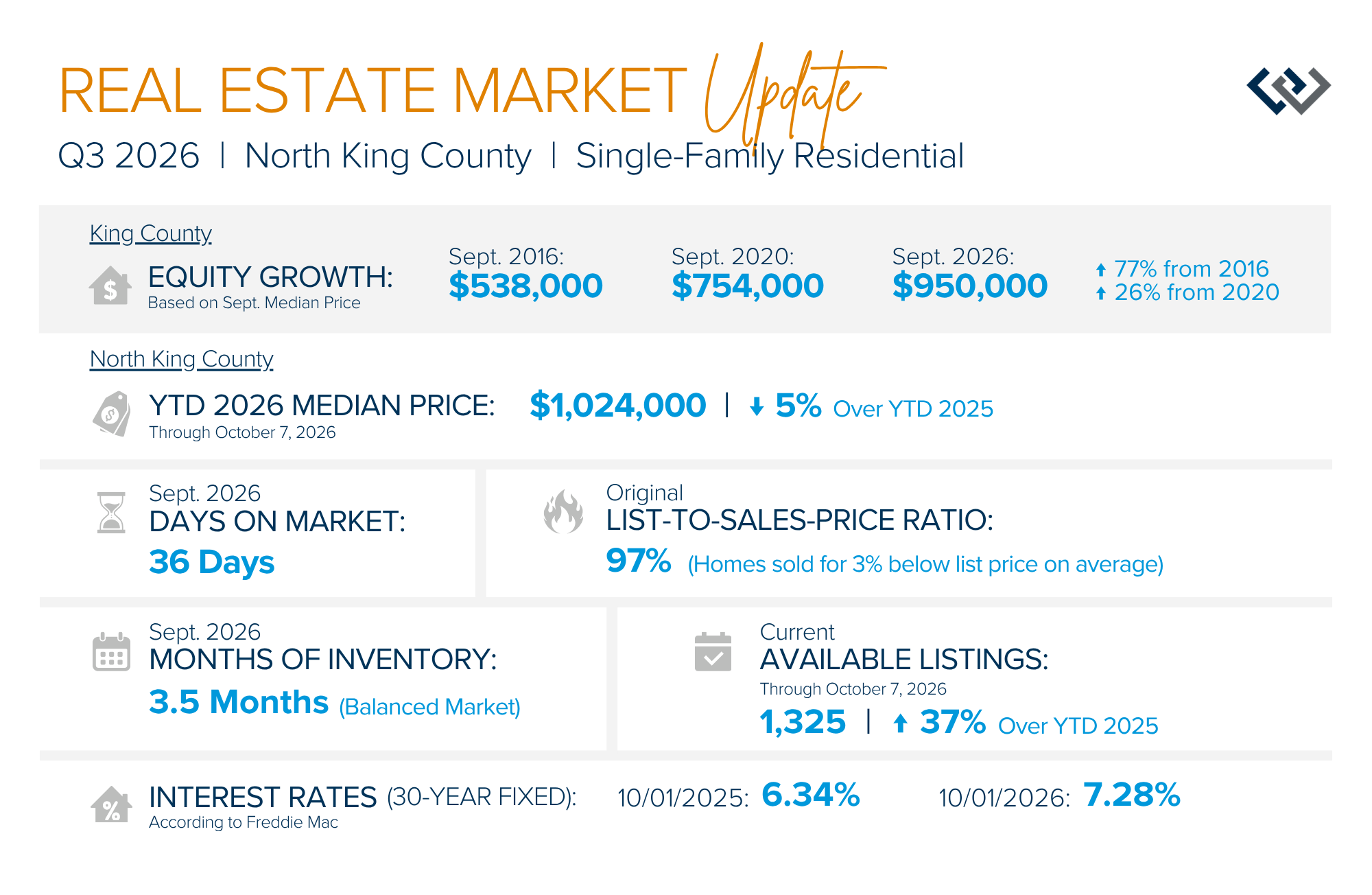
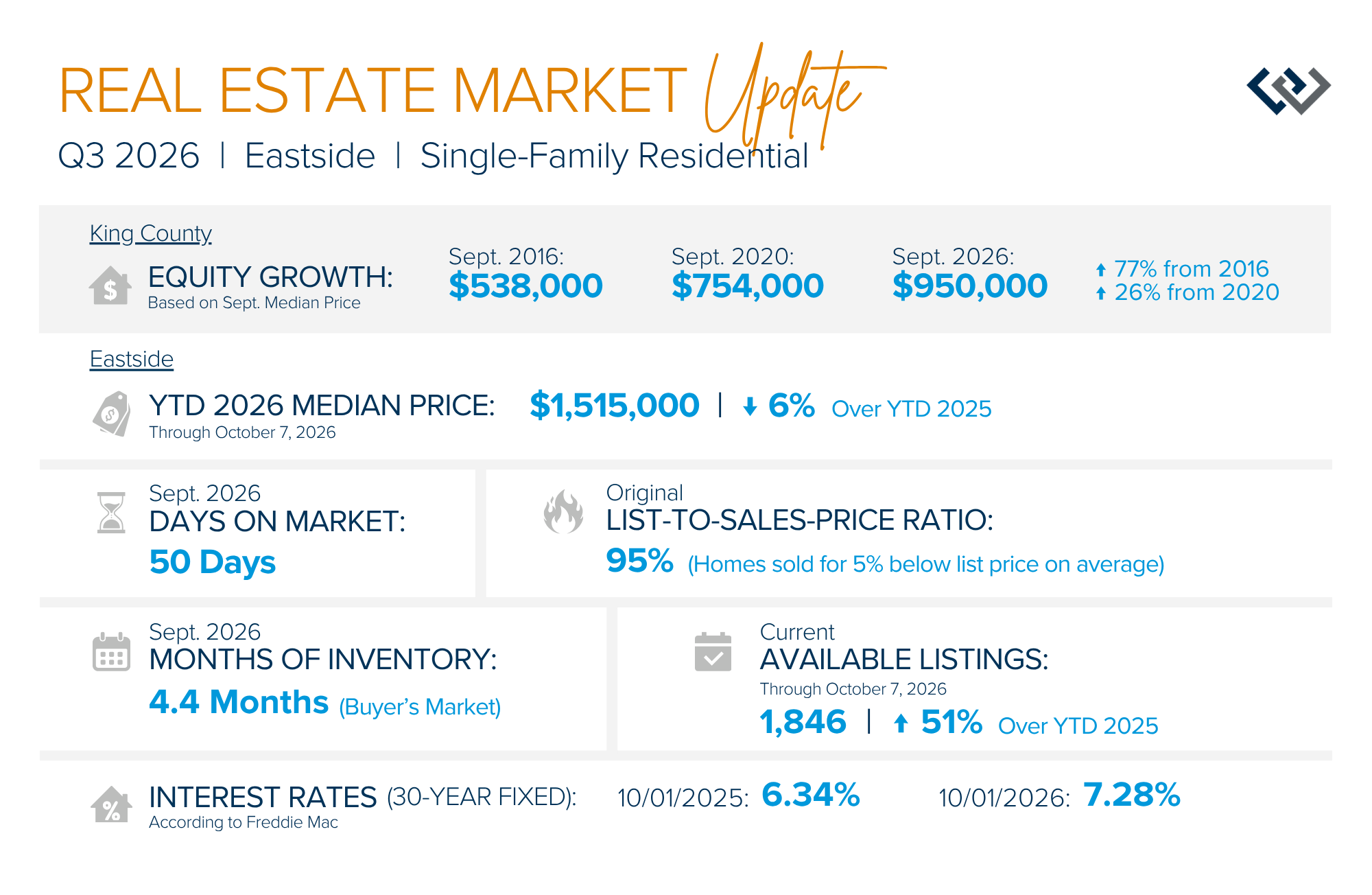
Real estate is always evolving, and today’s market is no exception. After years of rapid appreciation and intense competition, we’re seeing a return to more balanced conditions due to interest rates. Inventory is up, prices have adjusted, and homes are spending more time on the market.
For sellers, years of strong appreciation have established substantial equity, and well-prepared, accurately priced homes continue to attract buyers and create solid returns.
For buyers, this means more choices, greater negotiating power, including rate buy-downs and inspections, and the opportunity to make thoughtful decisions without the pressure of yesterday’s market.
While the market may look different than it did a few years ago, opportunities remain. Success today is less about timing the market and more about understanding it, having a plan, and making informed decisions. As always, real estate is local, and I’m here to help you understand what these trends mean for your home and your goals. Please reach out to learn more.
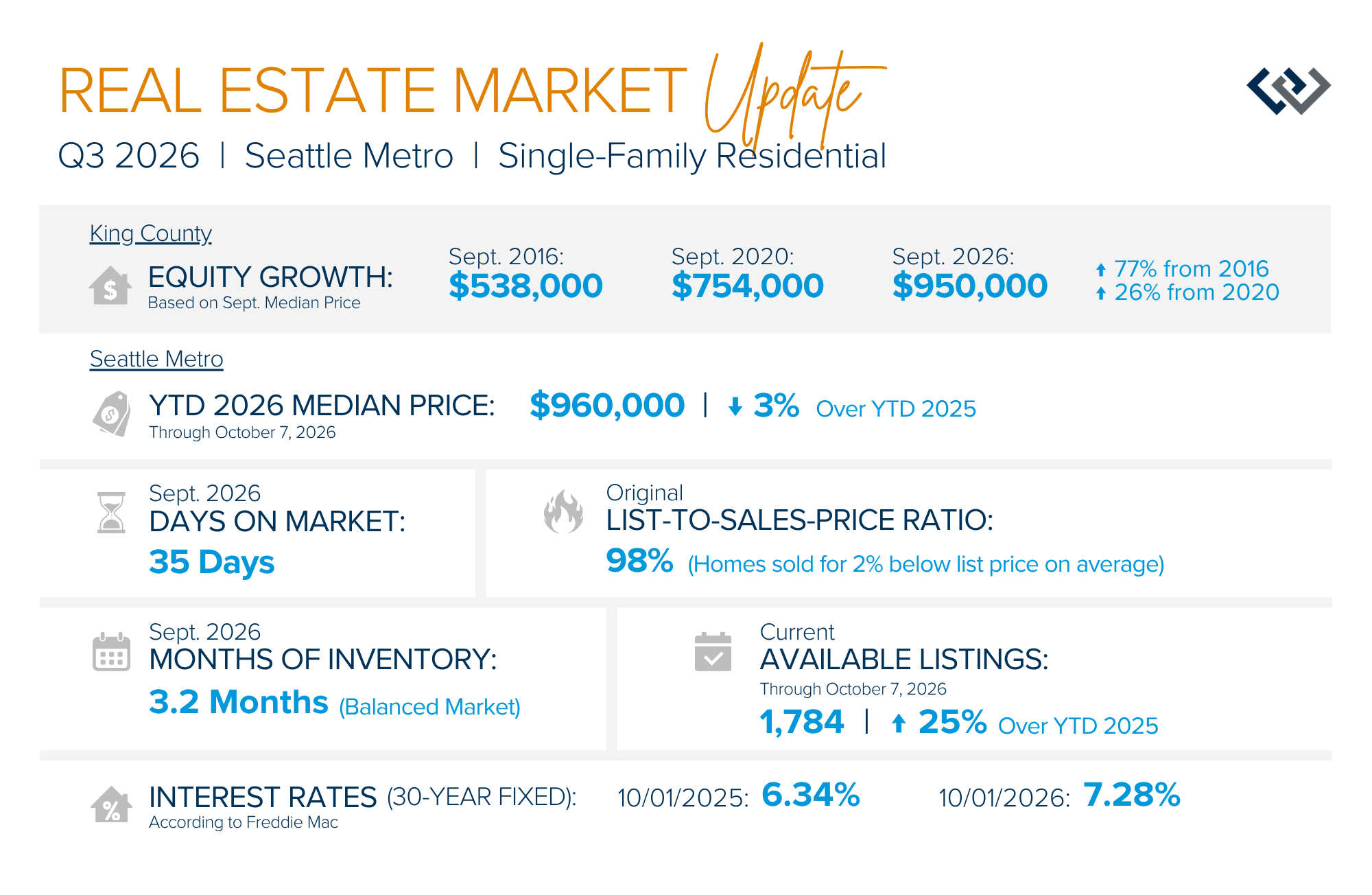
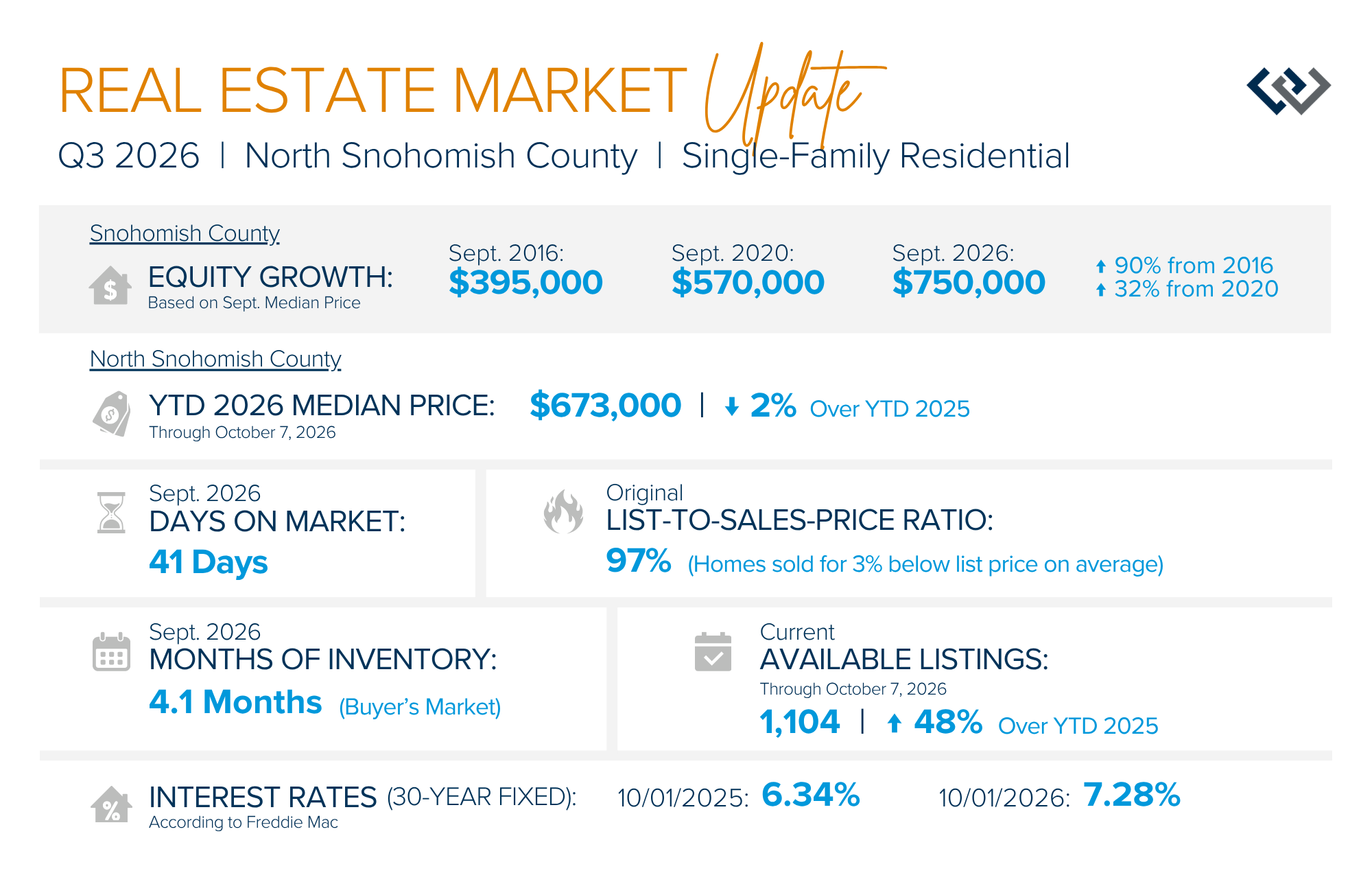
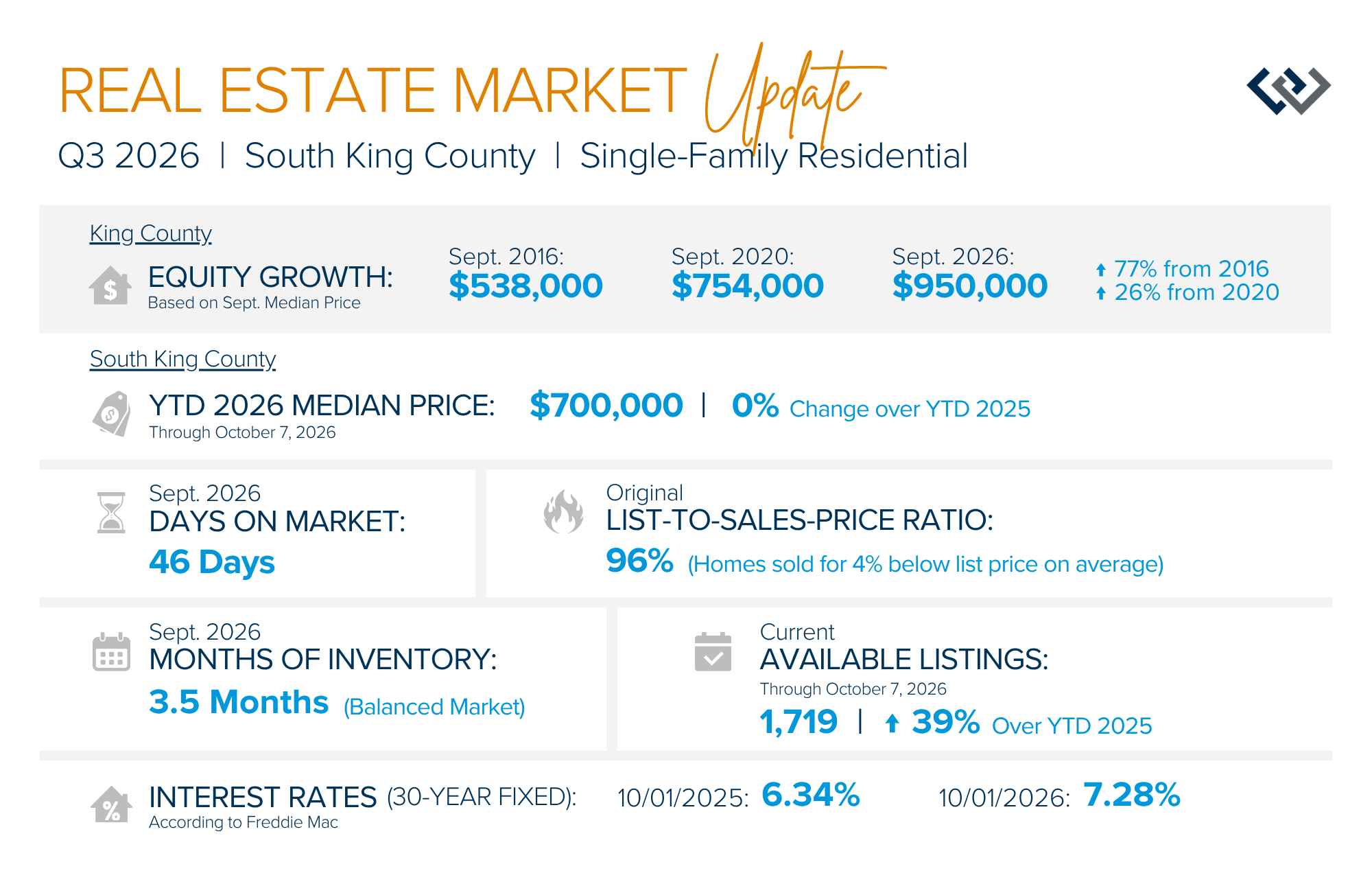
A Flight to Quality: Presentation, Accuracy & Representation Wins

You may be reading the headlines and heard that the real estate market across our country and locally is shifting. In King and Snohomish counties, for both single-family residential (SFR) homes and condos, I can confidently say that inventory has increased across the board, and it is taking longer to sell a property due to increased selection and higher interest rates.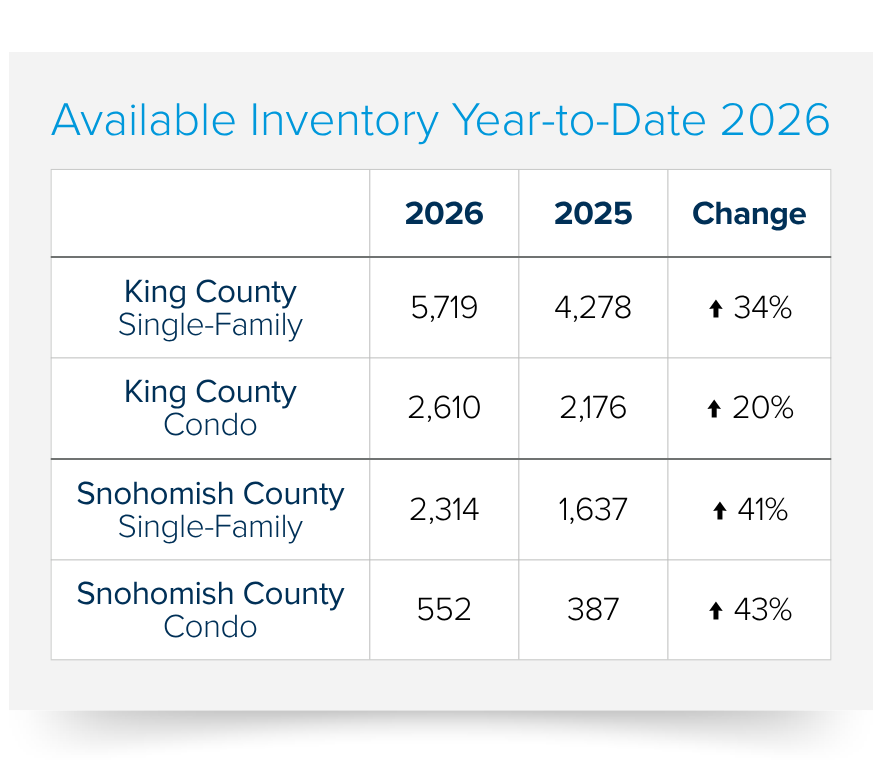
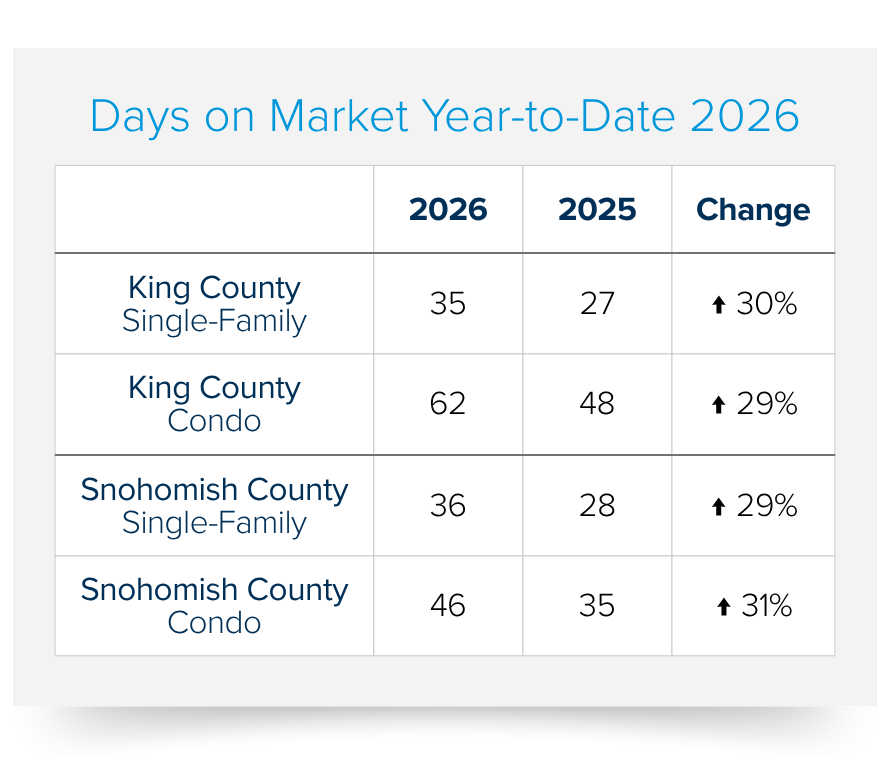
What varies from one zip code and/or city to the next are prices and equity. In some areas prices are up year-over-year, and in others, they are either flat or down. Some areas are affected more than others with downward pressure on prices, so having a skilled professional help you assess your value really matters. We are seeing many misplaced homes in the market, mostly due to pricing too high and/or inferior property condition. What I can also say for sure is that accuracy and quality matter in a sea of quantity and that long-term equity growth is strong.
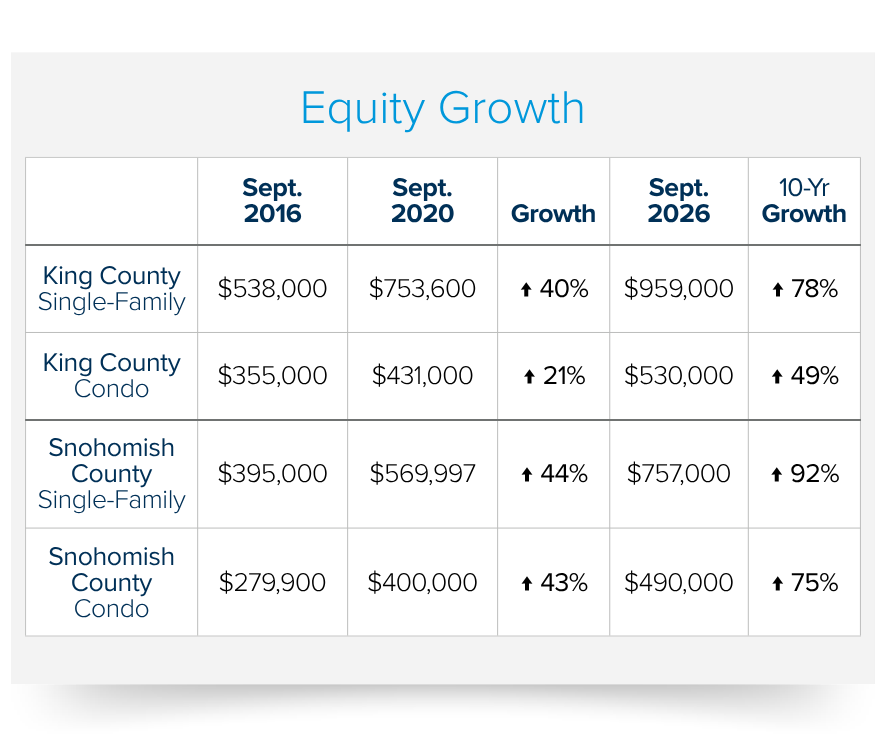
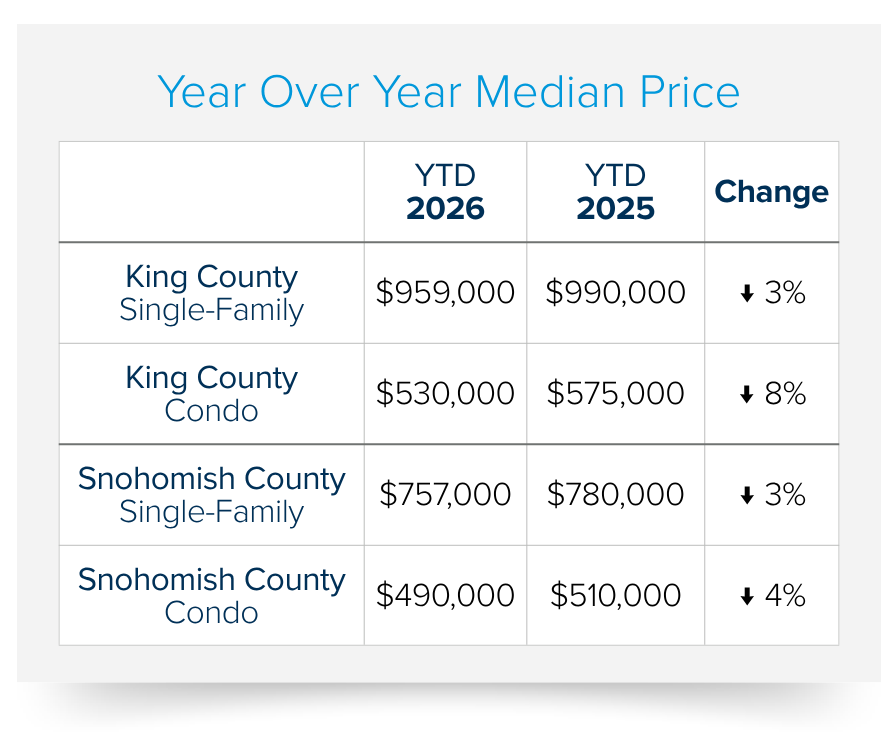
When a home is brought to market accurately priced and properly prepared for market along with a strong equity position, sellers are winning! Keeping perspective on pricing by marrying the long-term gains with the current environment at the forefront has been the guiding light to a smooth sale and positive financial return. Couple that with some patience in a more normalized market, and stress levels reduce as home sellers and skilled real estate professionals partner to reach the seller’s goals.
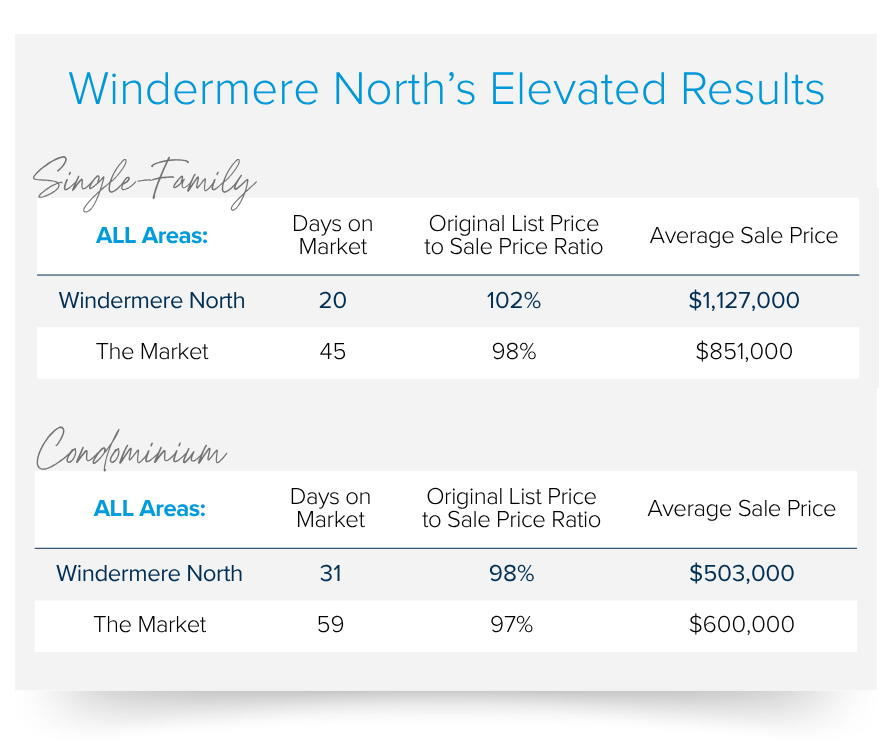
Consumers should be mindful of who they hire! Unfortunately, the barrier of entry into the real estate profession is low, so be selective and seek someone truthful, who does their research, has a detailed plan, and knows how to negotiate. Professionals who are excellent communicators and are data and process-driven are the ones who are rising above the crowd by leaning into the current market conditions to find success for their clients. Below are the stats for my office through June 30th 2026, compared to the rest of the market, and I’m happy to report we are creating exceptional results for our sellers with well-above-average days on market and list-to-sale price ratios.
With monthly payments rising due to higher loan costs year-over-year, buyers have become more discerning as they build their budgets and decide what they are willing to take on. The irony of this phenomenon is that buyers have been waiting for this increased level of selection, a slowdown in price growth, and more negotiating power for years! Yes, this opportunity is coupled with higher interest rates and stubborn inflation, but with more room to negotiate, we are seeing many buyers obtain seller credits to buy-down their rate or negotiate a price they feel good about.
Additionally, it is important to understand that real estate is a long-term hold investment. While we saw an intense ramp-up in prices during the pandemic and tech boom in our area, that is not the norm. This caused an illusion that one could turn a property in 1-3 years and make a profit. During the pandemic, we saw double-digit annual price appreciation in many areas. The softening we are seeing in prices is correcting the long-term annual appreciation average against the historically high ramp-up we saw from 2020-2023.
According to the National Association of Realtors (NAR), the average amount of time a person stays in a home before they sell is 11 years, and the average annual appreciation is 4.3%. This combination could result in a 59% increase in the investment through equity built, based on the averages. When buyers plan to purchase a home they can see themselves in for at least 6 years, they are caring for their investment and enjoying where they live at the same time. Of course, life can change, requiring one to move sooner, and having a skilled professional in your corner to help navigate this is key.
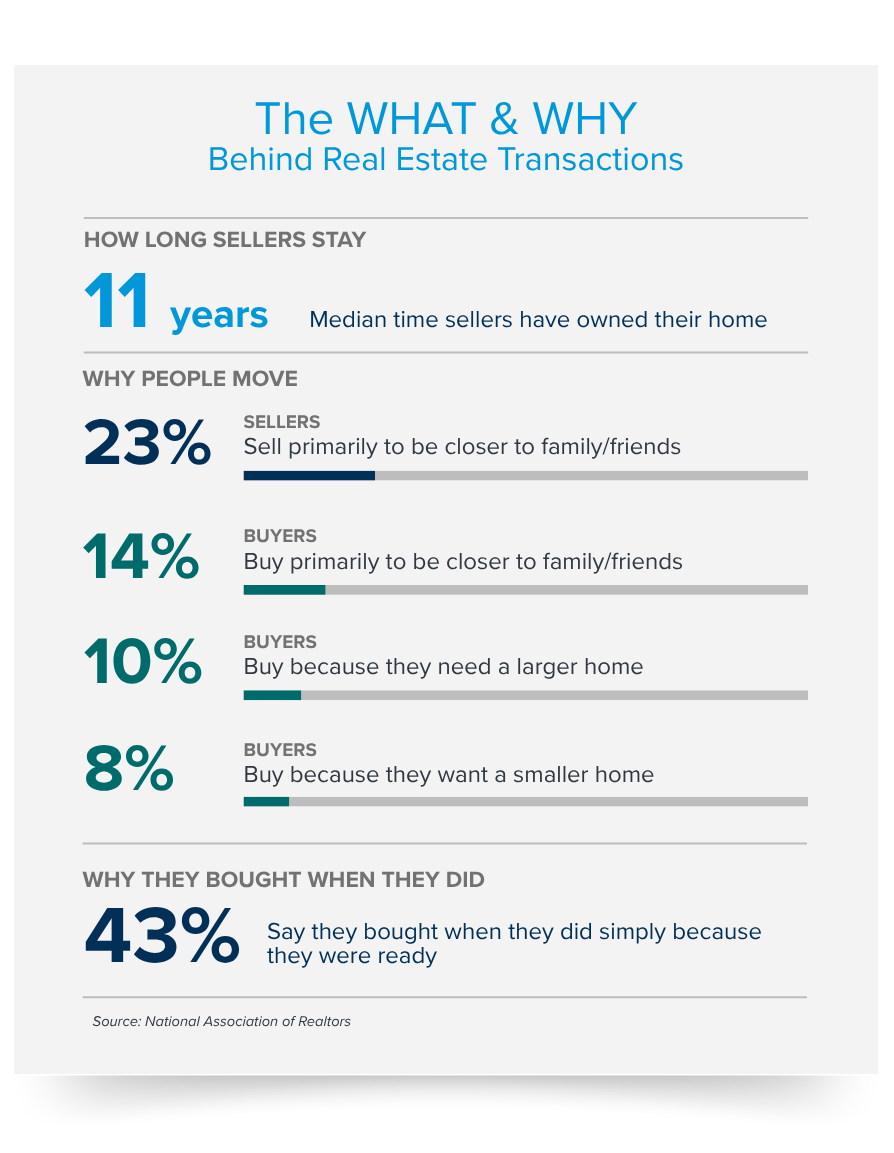
On the flip side, many home sellers are sitting on wide, positive spreads of equity, especially if they have owned their homes for more than 6 years; and those who have been in their homes for a decade plus have gained amazing household wealth by owning real estate. We are seeing many of those sellers come to market due to life changes such as a shift in family size, job change, retirement, or a planned move out of state. Many Baby Boomers are following their adult children and grandchildren or simply right-sizing to a house or location that better fits their lifestyle.
Trends we are seeing for buyers are shifting as well. On top of the fact that many home sellers are also home buyers (everyone needs a place to live), we have a large population of younger buyers trying to obtain their first homes. In 2025, first-time homebuyers only accounted for 21% of all buyers, and in June 2026, they accounted for 33% of all home buyers. More selection and less competition have allowed some first-time buyers to jump in and seize the opportunity of a more open market to start building wealth through real estate and ditch the rent payment.
This market is nuanced, and while we can make some sweeping statements about inventory, interest rates, and the time it takes to transact, every situation is unique and requires analysis. The recipe of one’s motivation for a move, equity position for a seller, affordability for a buyer, and how that marries to the market conditions can lead to great success for some immediately. It also may require building a plan for some to get prepared to make their move later. What I do know is this: if you’re curious about how your goals align with today’s market, you have to ask! And you should ask someone willing to get into the weeds of the data, discuss your goals, listen to your needs, and help you devise a plan that works whether it is now or down the road. I am here for that, always! Please reach out if you want to learn more about how this nuanced market applies to your unique set of circumstances.
Big Changes: What ‘First Look’ Means for Buyers & Sellers
The NWMLS (Northwest Multiple Listing Service), the shared database where broker members input their listings for sale to make them available to all the other broker members and where broker members search for listing inventory, made a big change on September 4th. As a result of the recently settled lawsuit with Compass, the new First Look status was created to allow an option to phase the marketing of a listing.
This did not allow a brokerage to create a private listing network where they would only share their listings within their own firm and lock out other broker members and/or limit access to the public, which would put the public and the membership at a disadvantage for the benefit of a single brokerage. Unlike Coming Soon listings that are common in markets outside of Washington State, First Look is an option that requires a brokerage to market their listings to the NWMLS database and possibly sell it before going to fully Active status.
In First Look status, a listing is input into the NWMLS database and is visible to all 30,000+ broker members. The maximum time a listing can remain in First Look status is 21 days. During the time a listing is in First Look status, a seller can choose to allow showings, open houses, and broker’s opens. These listings can sell during this time, as well. The seller can also choose to have the listing syndicate via the IDX (Internet Data Exchange) feed from NWMLS, to all third-party public-facing listing portals such as Zillow, Redfin, Homes.com, and Realtor.com, to name just a few of the thousands of websites the IDX reaches.
When in First Look status, if syndicated, the days on market and any price adjustments in First Look will NOT be sent to the third-party public-facing listing portals from the NWMLS. However, these key metrics will be displayed on the NWMLS database for all of the broker members to view. If a buyer is active in the market and does not want to “miss out” on a listing, they should strongly consider aligning with a broker who can forward the First Look listings that are not syndicated and to provide the listing insights that are most often only found on the NWMLS database.
- Brokers can set up auto-emails to be delivered to their buyers based on saved search criteria set by the buyer that will immediately send all First Look (and Active) listings to the buyer, so they have full access to all available inventory regardless of syndication. Brokers can also report to their buyers the days on market and price adjustment insights that occur in the First Look status most often only found in the NWMLS database to help buyers better assess the property.
In June, Washington State implemented a new law, SB 6091 RCW 18.86.130, requiring all listings to be marketed to the public and all brokers, barring health and safety concerns by a seller. Some members of the NWMLS have been requesting a status like First Look for some time. The result of the settlement granted this request and created guardrails to ensure it was compliant with RCW 18.86.130, which does not allow for private listing networks and promotes fair housing standards.
It is important for everyone that the new law is considered when choosing to not syndicate a listing to all the public-facing listing portals. The new law was put in place to ensure a fair and open marketplace for all and to promote the concept of fair housing. Further, maximum exposure of a listing most often results in the highest return and best terms for a seller by making it available to the largest audience of buyers possible versus a select group.
Why would a seller consider doing a First Look status before going fully Active in the NWMLS?
- They want to make the broker community and the public aware that their listing that is not ready for showings, is coming for sale and to create excitement. This could be especially effective if there is a similar competing listing available that is drawing attention by letting buyers know they could have an additional option.
- If a home is unique and difficult to price, this time frame could provide pricing feedback via showings without posting days on market and price adjustments on the public portals via the NWMLS syndication feed. Once adequate feedback is received (within the 21 days), a seller could adjust accordingly and go to full Active status at a price based on the feedback, with 0 days on market published once Active.
- They may want to showcase curated marketing such as video, social media campaigns, and print media and/or gather staffing for open houses without violating NWMLS rules and RCW 18.86.130, which don’t allow pre-marketing before being input into the NWMLS database and marketing to the public.
- If a buyer secures a property to purchase contingent on the sale of their home which requires them to quickly get their home in the NWMLS database per the purchase and sale contract, this allows them to do this immediately while they may still be preparing the property for full Active status.
What is important for consumers to understand?
- The First Look status is an option and not a requirement. In fact, we anticipate that it will not be used most of the time, but when the situations above arise.
- Aligning with a broker will ensure a buyer has access to fully non-syndicated First Look listings, so a buyer does not miss out on all available inventory since a listing can sell during First Look status.
- Aligning with a broker will ensure a buyer has access to the days on market and price adjustment insights during the First Look status which will likely not publish outside of the NWMLS database since these insights will not syndicate to the third-party public-facing search portals in First Look status from the NWMLS.
- Listing syndication to all third-party public-facing portals ensures maximum exposure to all the public, especially buyers who are not aligned with a broker. This typically results in the most favorable outcome for a seller.
These changes have come fast, and the market will adapt. I am continually committed to staying on top of the ever-changing landscape, including industry shifts such as First Look, along with the current market conditions and trends to best serve my clients. If you have any questions or want to discuss what is happening in the market in relation to your goals, please reach out. It is always my goal to educate, inform, and empower through data, insights, and experience to assist my clients in making strong financial decisions and better their lives. Here’s to moving forward aligned, aware, and with the best outcome for my clients at the forefront.
Buyers Take Note: Balance is Beautiful
As summer winds down and we head into fall, some major developments are taking shape in our local housing market, and buyers should take note. Inventory is the highest it has been in a decade, providing buyers more choices after a long haul of limited selection, resulting in a balanced market. This has caused prices to remain flat, and although interest rates remain stubborn, they are slightly less than they were a year ago.
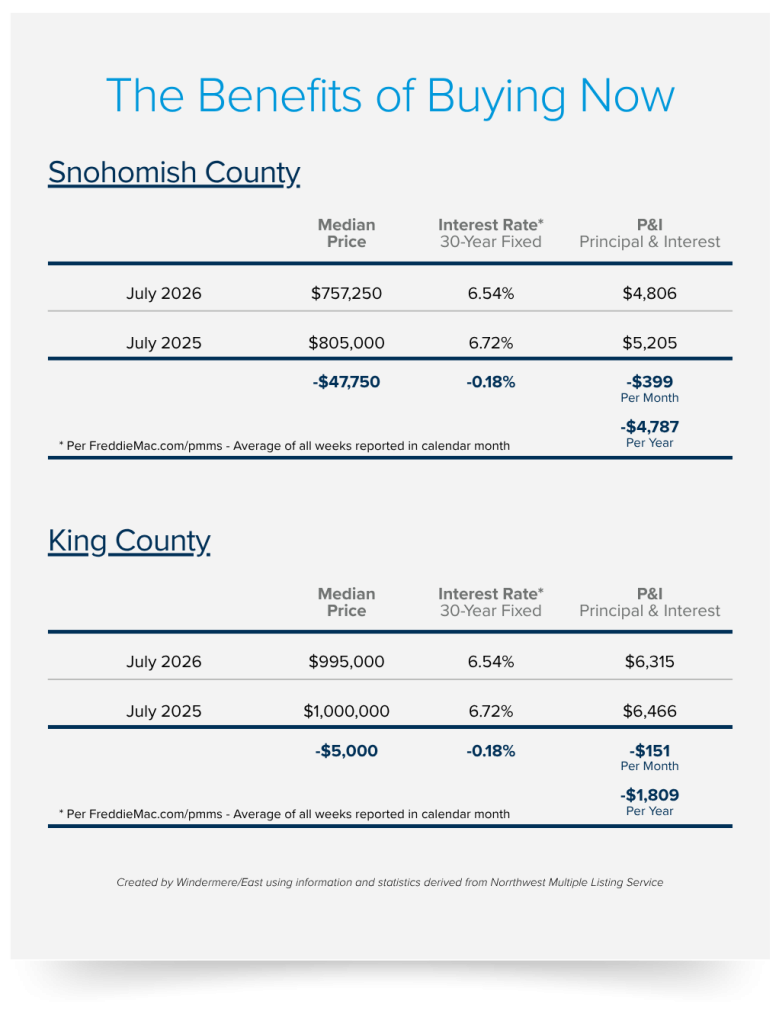
This has resulted in lower monthly payments. As you can see from the charts below, the principal and interest payment for a Single-Family home in King County based on the July 2026 median home price is $151 less than a year ago, and for Snohomish County, $399 less. These charts are based on the median sales price and do not consider the size of the down payment, which would further lower the payment. Down payments have been averaging around 20%, but we see many buyers putting down 3-10% as well.
With 25% more single-family homes to choose from in King County and 33% more in Snohomish County year-over-year, buyers are enjoying the benefits of a balanced market rather than the tight seller’s market that has been present for a decade. The charts below, which outline inventory levels and months of inventory, show the dramatic shift that has occurred over this summer compared with prior years. Months of inventory illustrates the number of months it would take to sell out of homes based on the current pending sales rate, which results in either a seller’s market (0-2 months), balanced market (2-4 months), or a buyer’s market (4+ months). We are currently experiencing a balanced market.
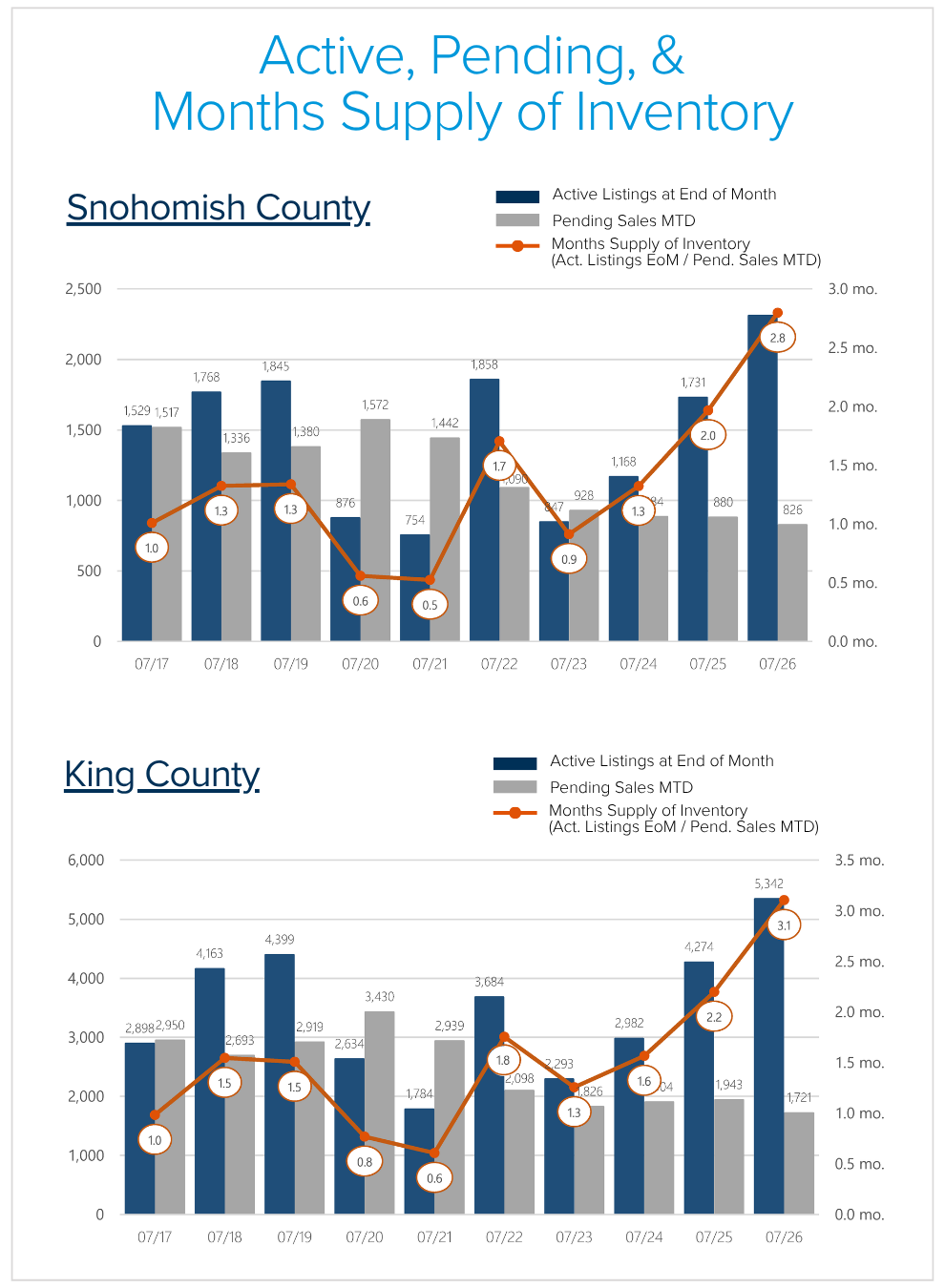
What does this mean for affordability? Not only are monthly principal and interest payments lower, but buyers are enjoying more negotiating power. In our office, 25% of the pending sales from June 15th through August 10th recorded buyer credits with an average credit of $16,000. Many buyers are using these credits to offset their closing costs, requiring less cash at closing, or they are using them to strategically buy down their interest rates, lowering their monthly payments even more.
For example, if a buyer were to utilize a credit to reduce their interest rate by half a point, their monthly payment based on the median price in King County would be $324 lower and in Snohomish County $246 lower. Between the year-over-year reduction in rate, plus a half a point buydown, a buyer would save $475 a month in King County and $645 a month in Snohomish County year-over-year (see example below). That is an annual monthly payment savings of $5,700 in King County and $7,740 in Snohomish County, and total savings of $171,000 over the course of the 30-year loan in King County and $232,200 in Snohomish County. These figures are large, and they are real!
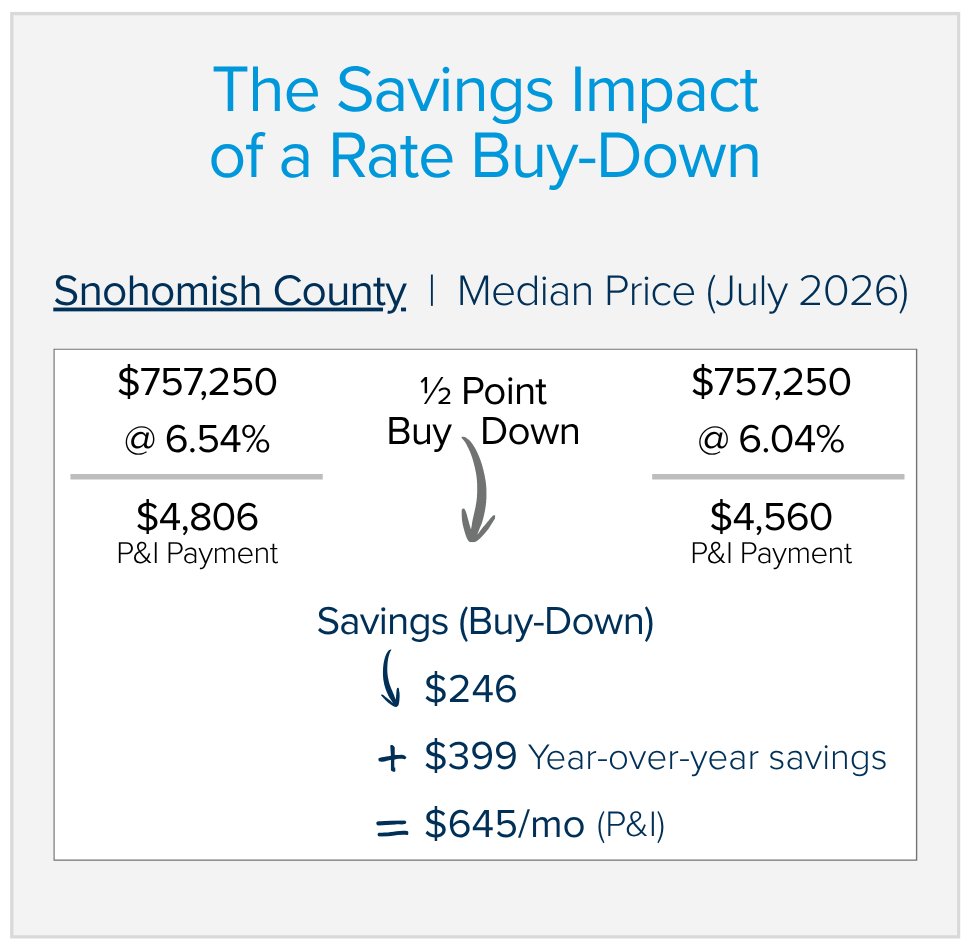
When a buyer takes the market at face value and sees more inventory, longer market times, and flat prices, they might think something is wrong and pause. When inventory was more constricted and the market more frothy, buyers were more apt to jump in and pay even though it was more expensive. It seems like silly psychology, but it is understandable that buyers feel more comfortable when others are also active. The buyers who understand the opportunities that are available to them right now, in a quieter time, are benefiting by saving money!
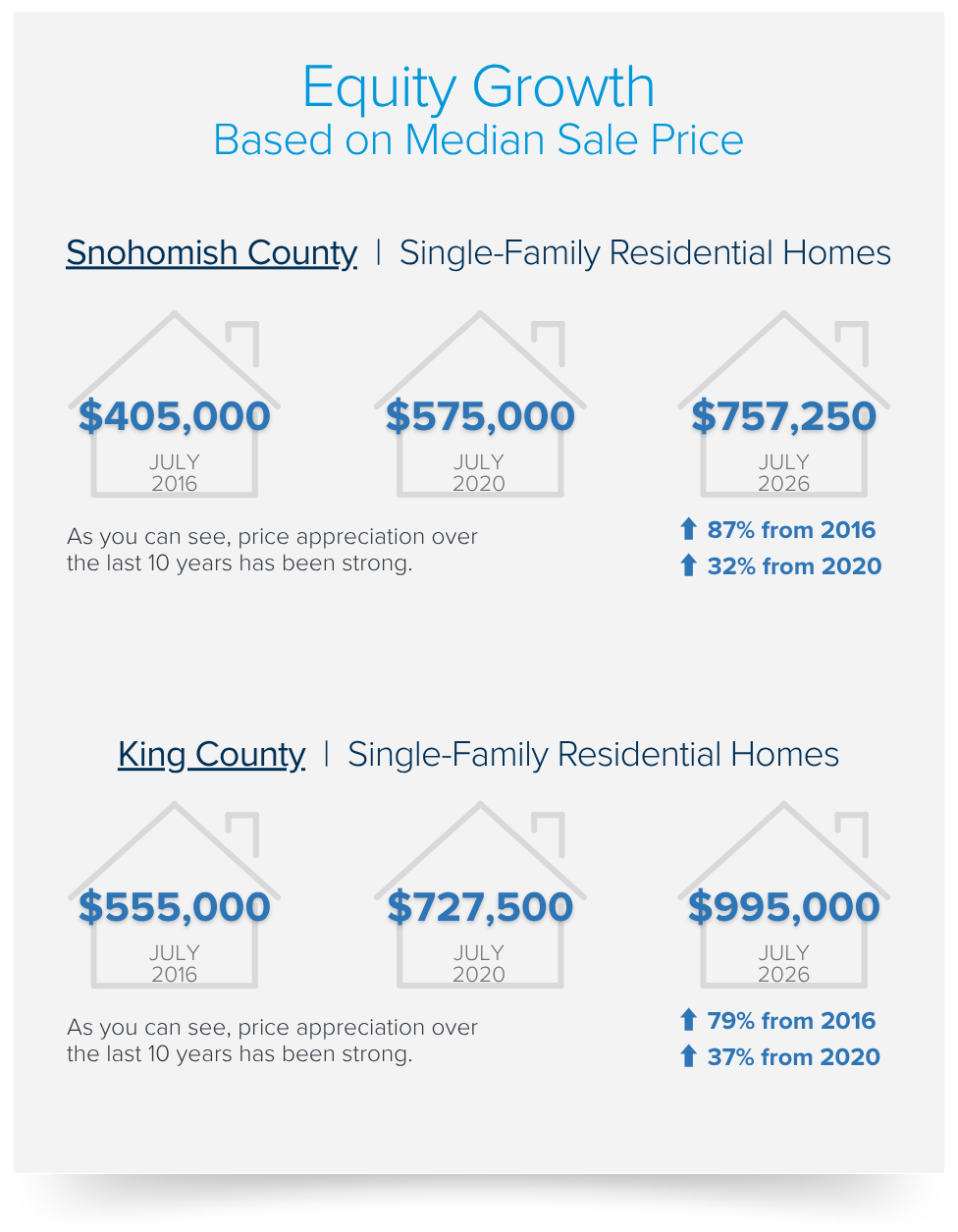
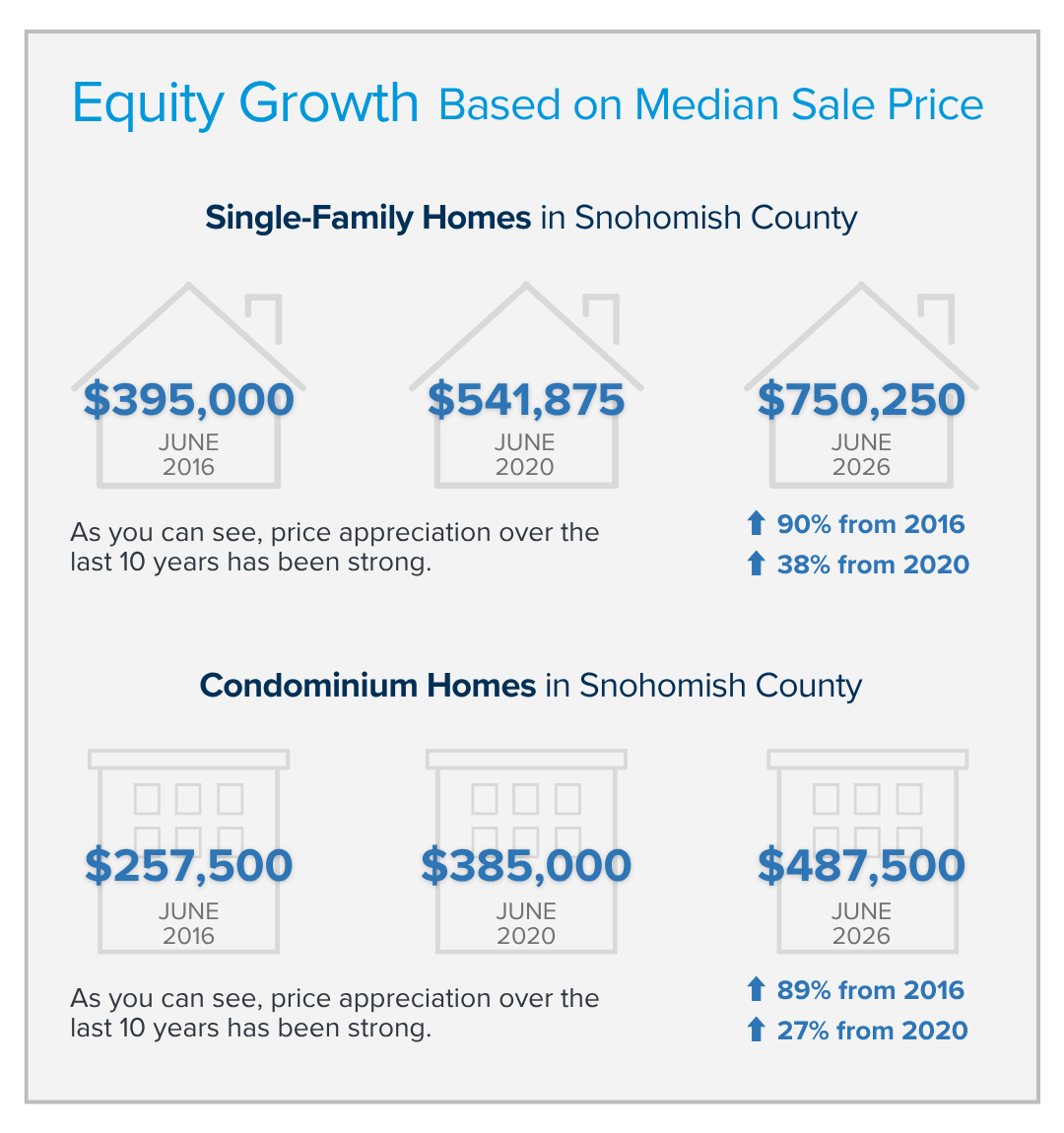
Another important aspect to understand is that real estate is a long-term hold investment. It is not only where you live and enjoy your life, but also an asset. As you can see in the images below, over the last 10 years, single-family homes have appreciated by 79% in King County and 87% in Snohomish County. This does take into account the massive price growth that happened in the pandemic, but it also shows year-over-year growth prior to the pandemic, ensuring that real estate is an amazing asset to have.
The key highlight to note in this balanced market is that the sky is not falling. Far from! 41% of homes that sold in July 2026 in King County sold at or above list price, and 39% in Snohomish County. Some homes are still seeing bidding wars and escalations. How a seller brings their home to market matters now more than ever with more inventory. Property condition, presentation, marketing, and pricing all play into the attention and results a home gets amongst the competition.
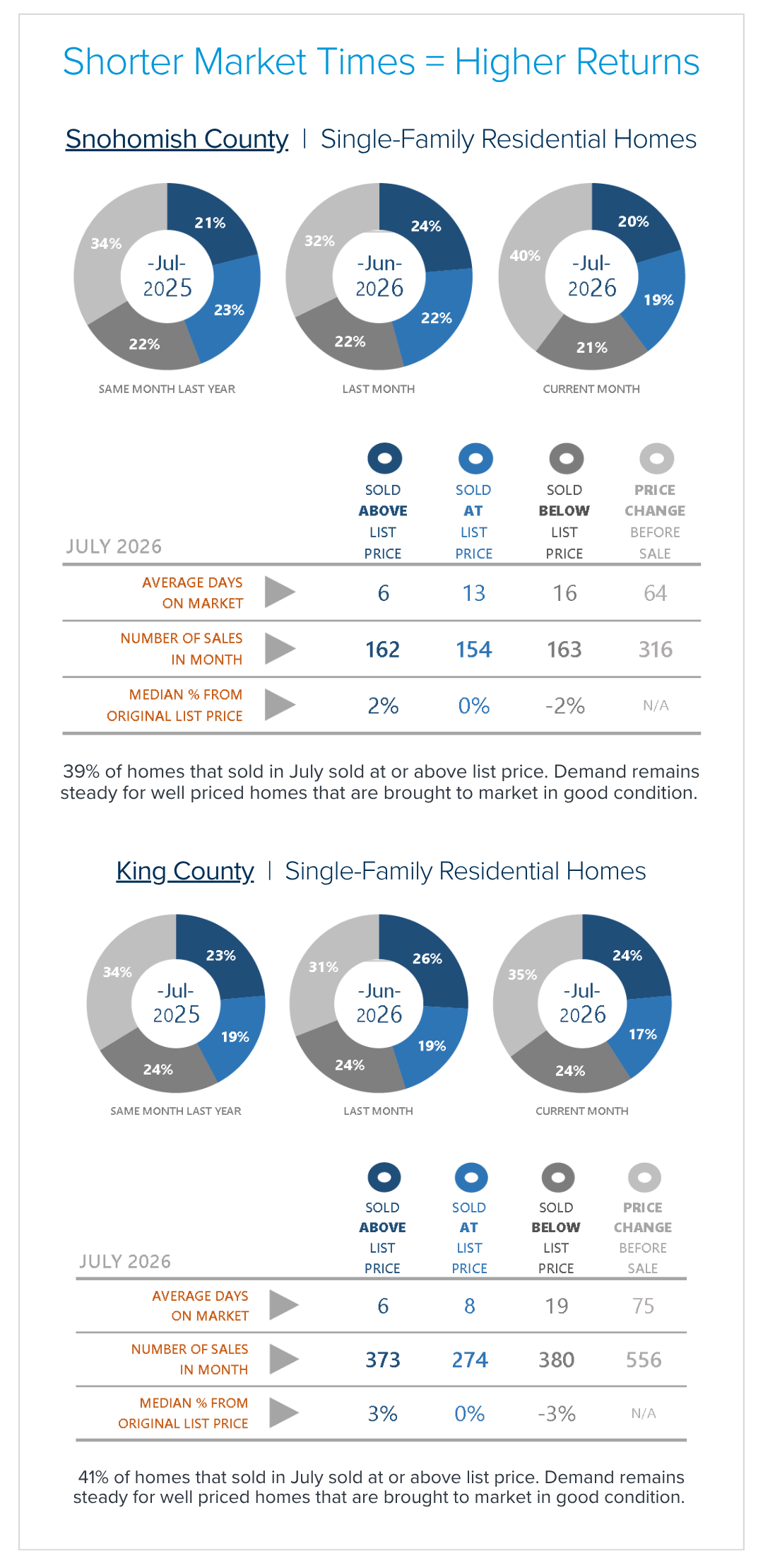
Success is being had on both sides of the market (buyers & sellers), and this is why it’s called a balanced market. This should be a welcomed phenomenon, not a scary one. If you have interest in learning more about today’s market or are curious about how your goals align, please reach out. It is always my goal to lead with the data to help educate my clients, so they are empowered to make strong decisions.
Exceptional Results Start with Exceptional Representation

Every real estate market is different. Some move at lightning speed, while others require patience, strategy, and precision. Today’s market demands more than simply putting a home on the MLS or writing an offer, it requires being rooted in the data and understanding buyer behavior, pricing strategically, knowing when to negotiate, and positioning a home to stand out.
That’s why the experience and resources behind your representation matter.
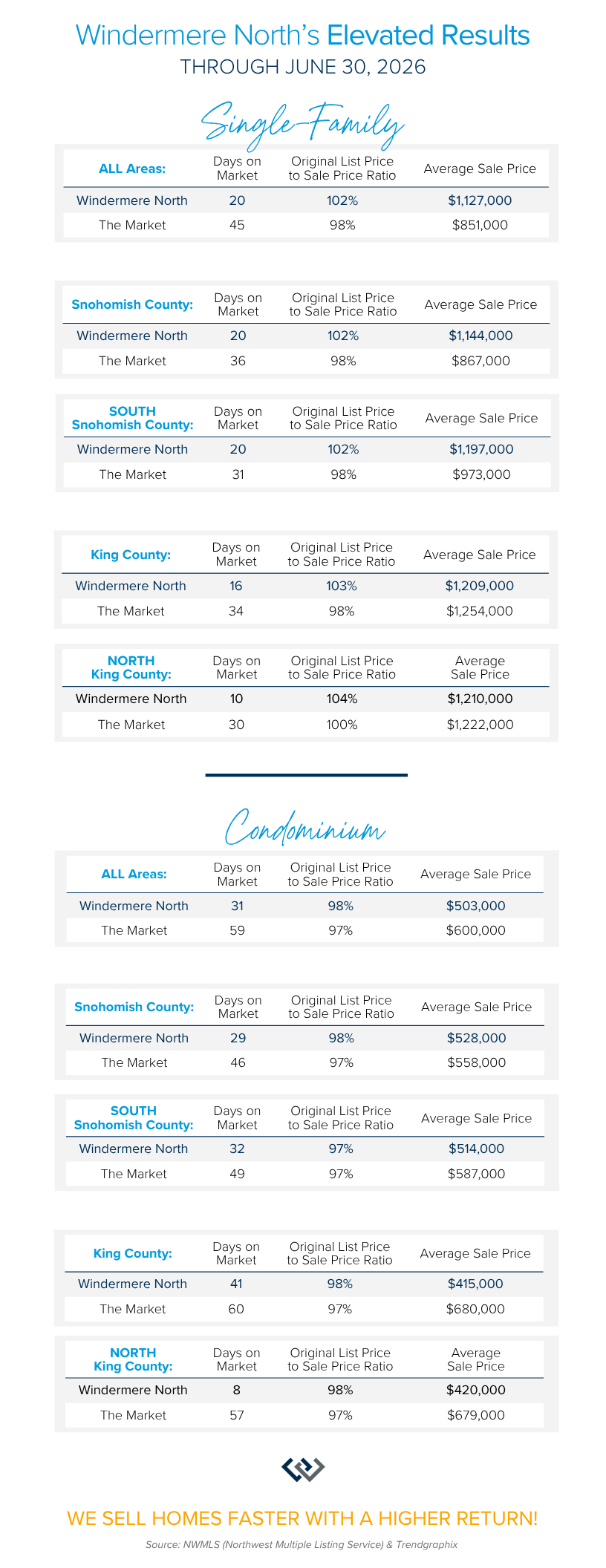
Through June 2026, homes represented by my office, Windermere North, sold considerably faster than the broader market while also achieving stronger sale-price-to-original list-price ratios. Across the areas we serve, listings averaged 16–20 days on market, compared with 30–45 days for the market overall, while achieving 102–104% of original list price versus 98–100% across the broader market.
I’m fortunate to be part of an office that consistently invests in market knowledge, marketing, technology, collaboration, and professional development. Just as important, I believe those resources only make a difference when paired with personal attention, thoughtful strategy, and a genuine commitment to each client’s goals.
Those numbers aren’t about one individual, they’re the outcome of a thoughtful process and are measurable to our clients’ positive bottom line. As you can see from the chart below, nearly half of the single-family residential sales in King and Snohomish counties are selling at or above list price and the other half are selling under list price or taking price reductions. For condos, a third are selling at or above list price, and the other two thirds are selling for under or taking price reductions.
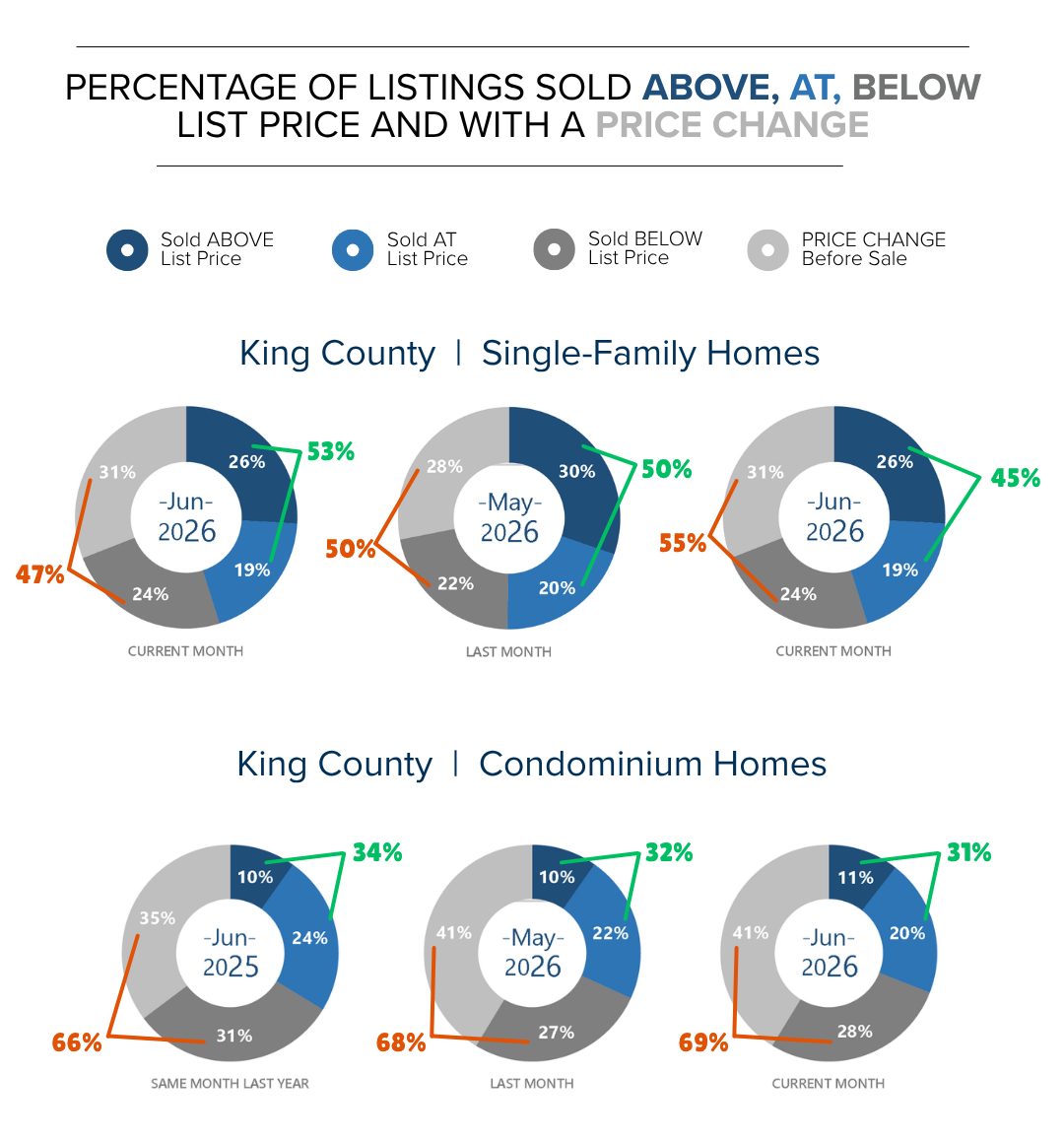
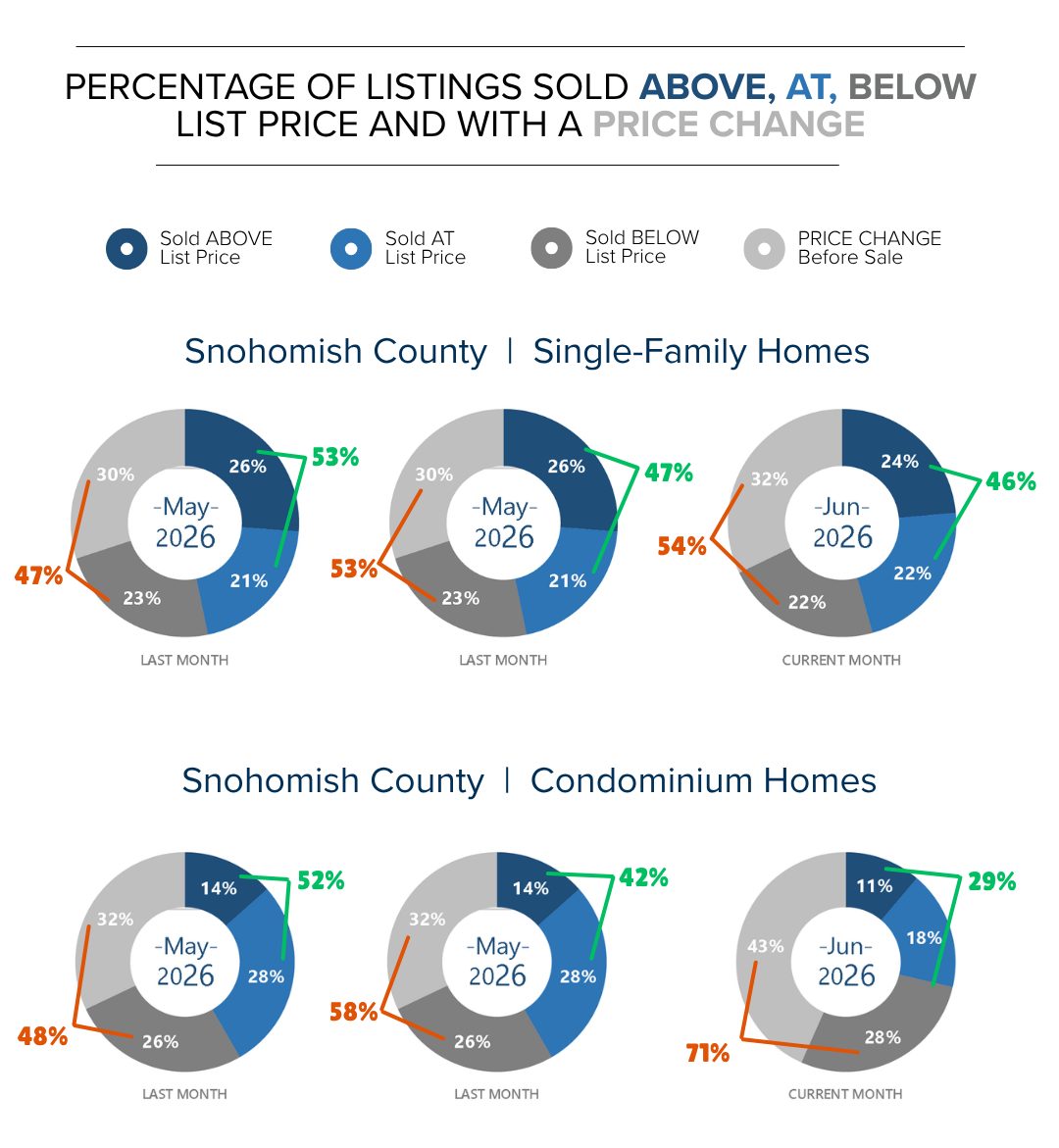
The opportunity to find yourself in the blue versus the grey comes from careful preparation, accurate pricing, exceptional presentation, strategic marketing, skilled negotiation, and clear communication from beginning to end. It also comes from having someone who understands how markets change and knows when to adapt the strategy. This all starts in asking lots of questions, hearing your goals, and devising a plan that will work in today’s market. With higher inventory (buyers: you have some awesome opportunities right now), it is critical that no steps are skipped in regard to property preparation and that pricing is dialed.
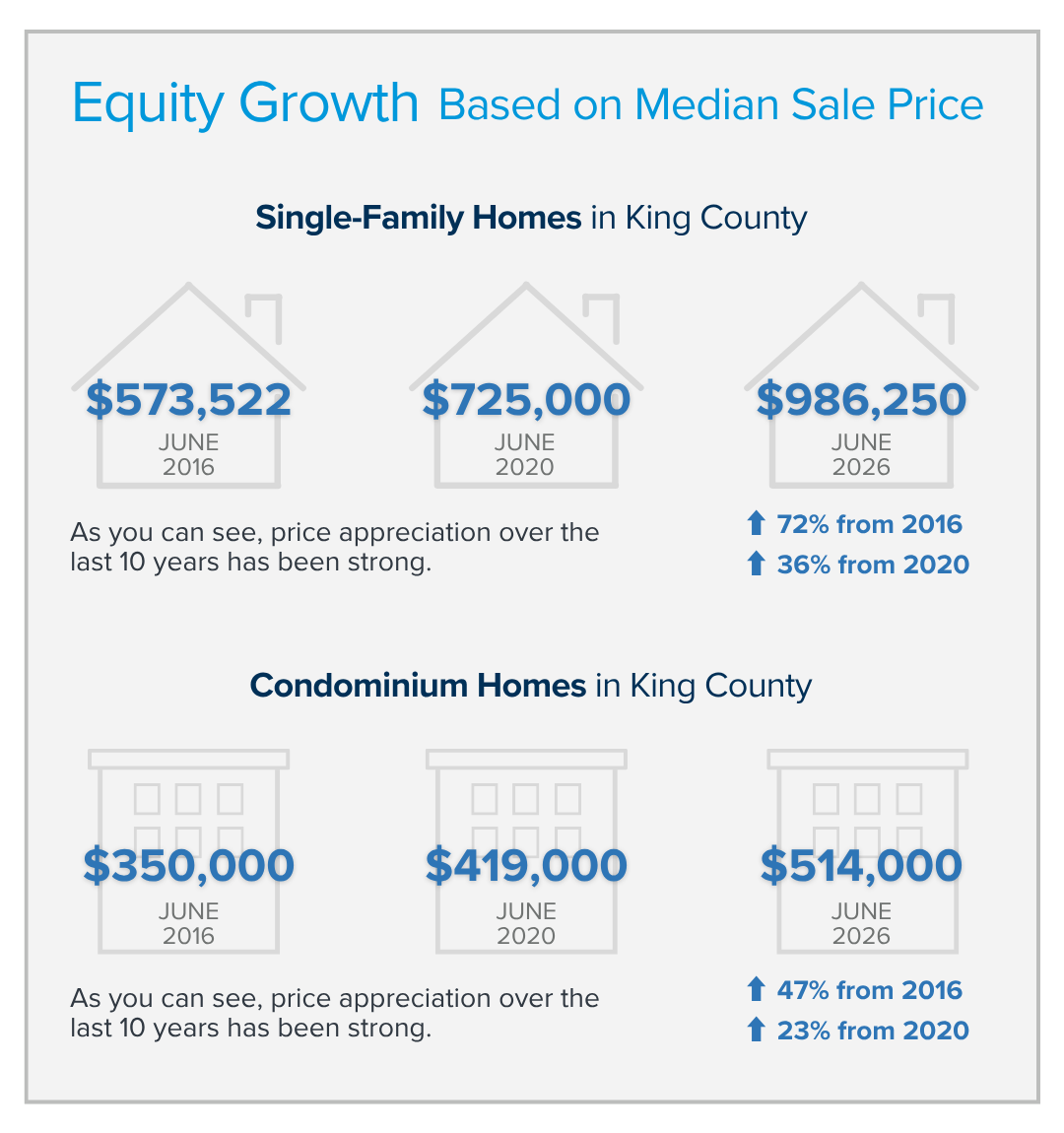
Another important aspect to consider is the long-term equity growth we have seen in our area. While prices have been flat year-over-year and in some cases down slightly, the growth displayed in the graphs below show the immense equity growth over the last 5-10 years. Further, if you have been in your home longer than 10 years, the options to reposition this wealth into a home that better fits your current lifestyle are plentiful.
Whether you’re buying your first home, selling a place you’ve loved for years, or making your next investment, you deserve someone who is continually studying the market, paying attention to the details, and advocating for your best interests every step of the way.
Real estate is one of the most significant financial decisions most people make. The right guidance can make a meaningful difference, not only in the final outcome, but in how confident and supported you feel throughout the process.
For me, that’s what experience is really about. It’s not about years in the business or accolades. It’s about showing up prepared, working diligently, staying informed, and caring deeply about helping clients make smart decisions, no matter what kind of market we’re in.
QUARTERLY REPORTS Q2 2026

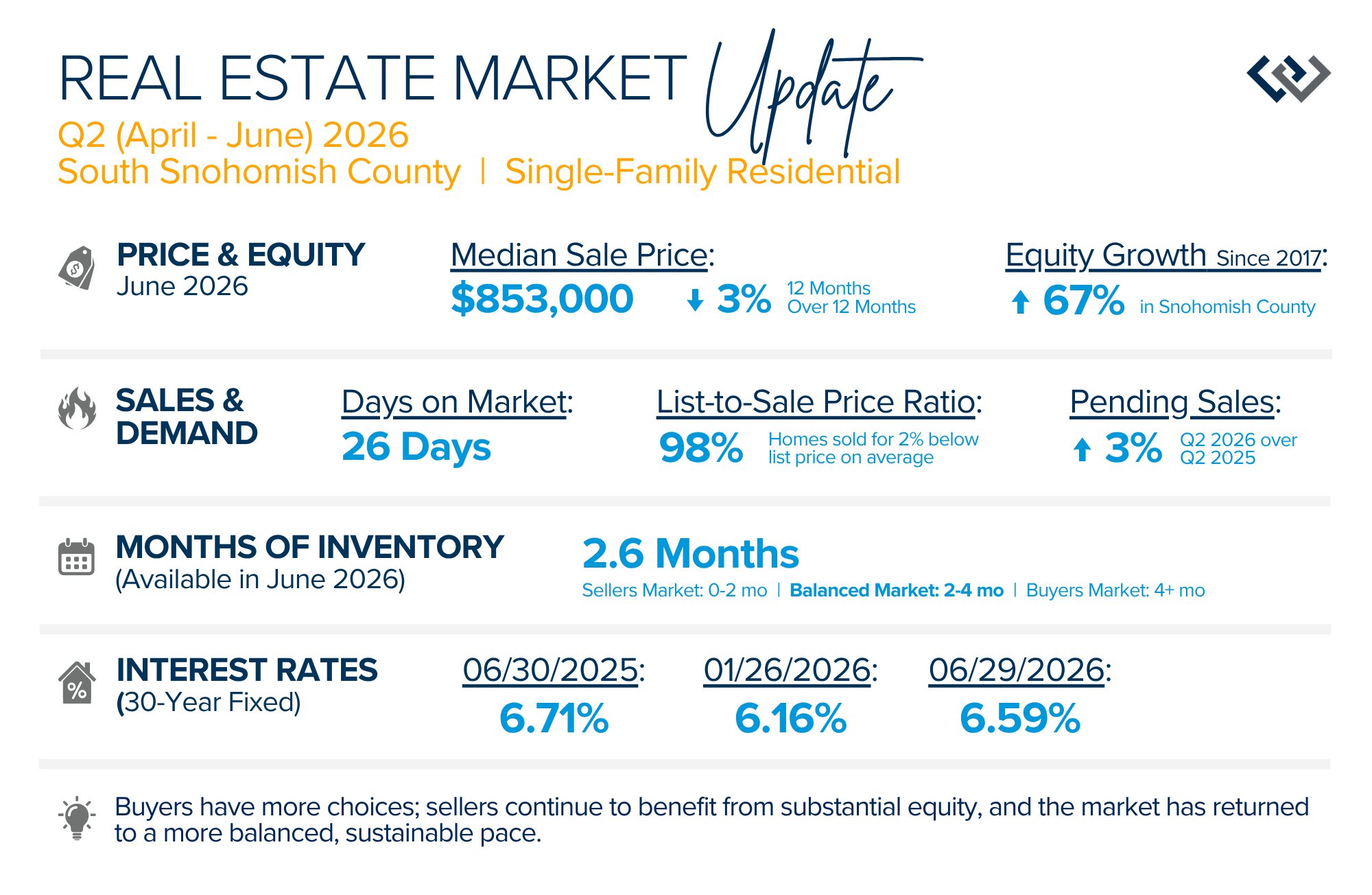
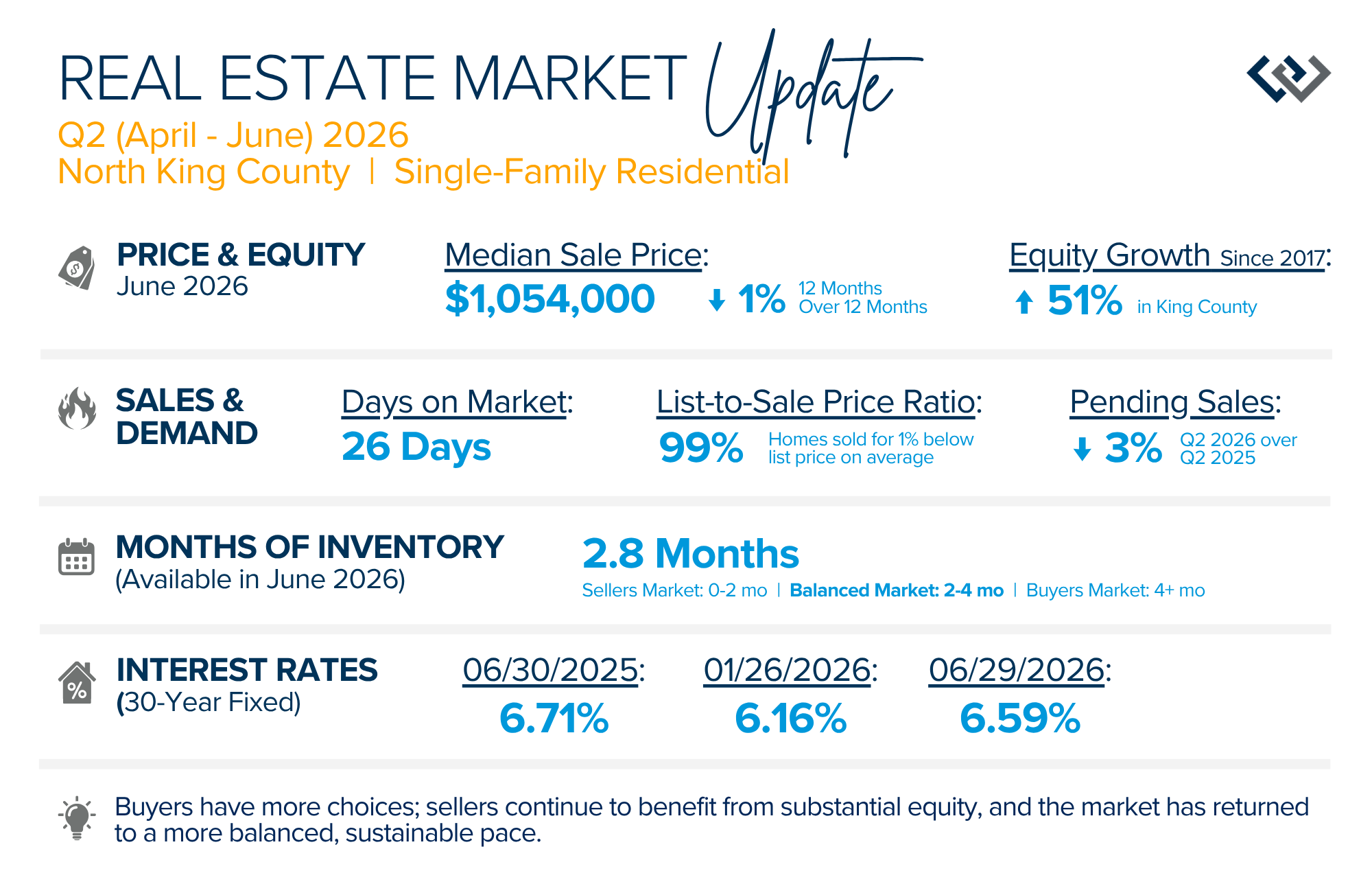
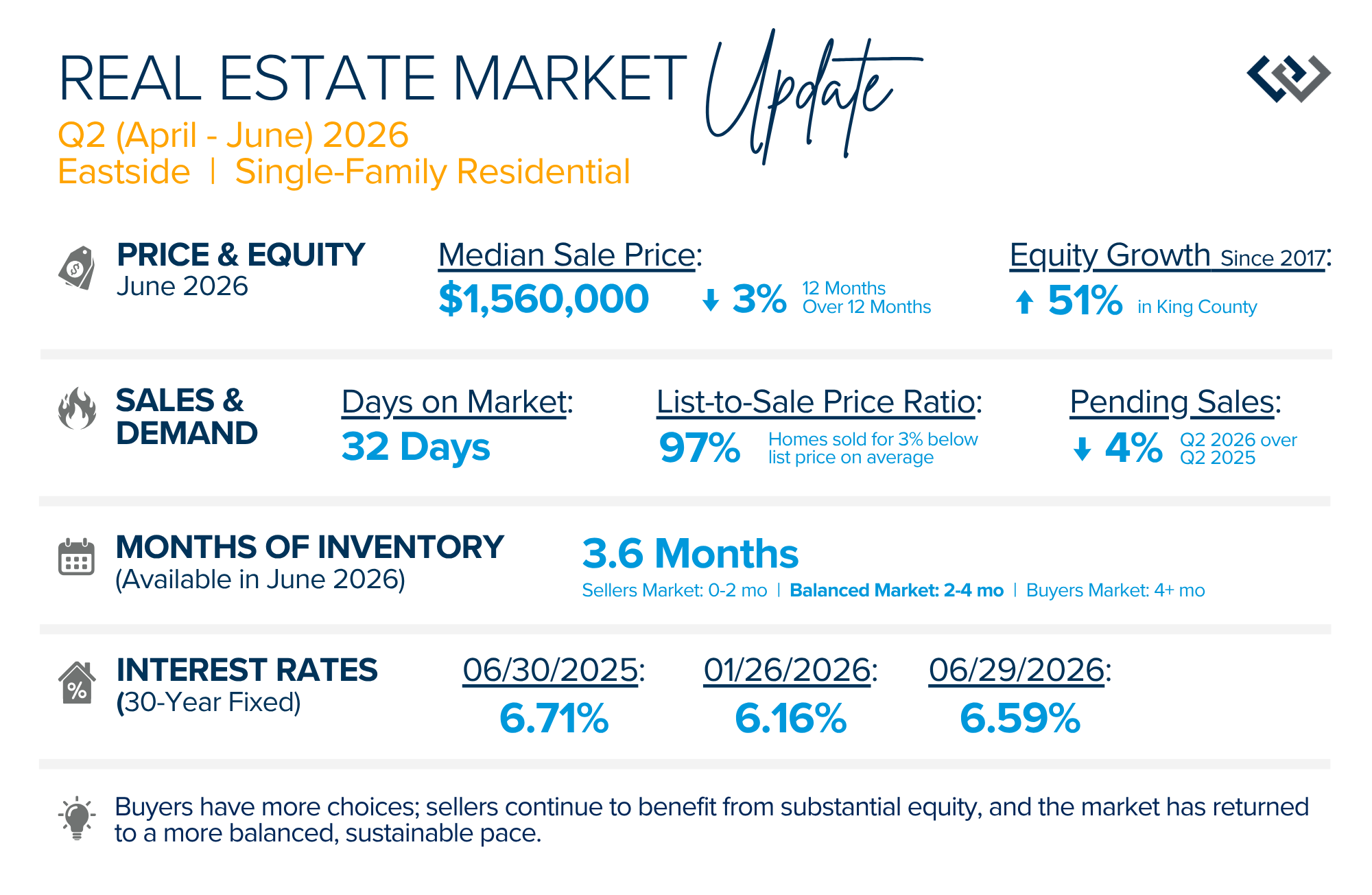
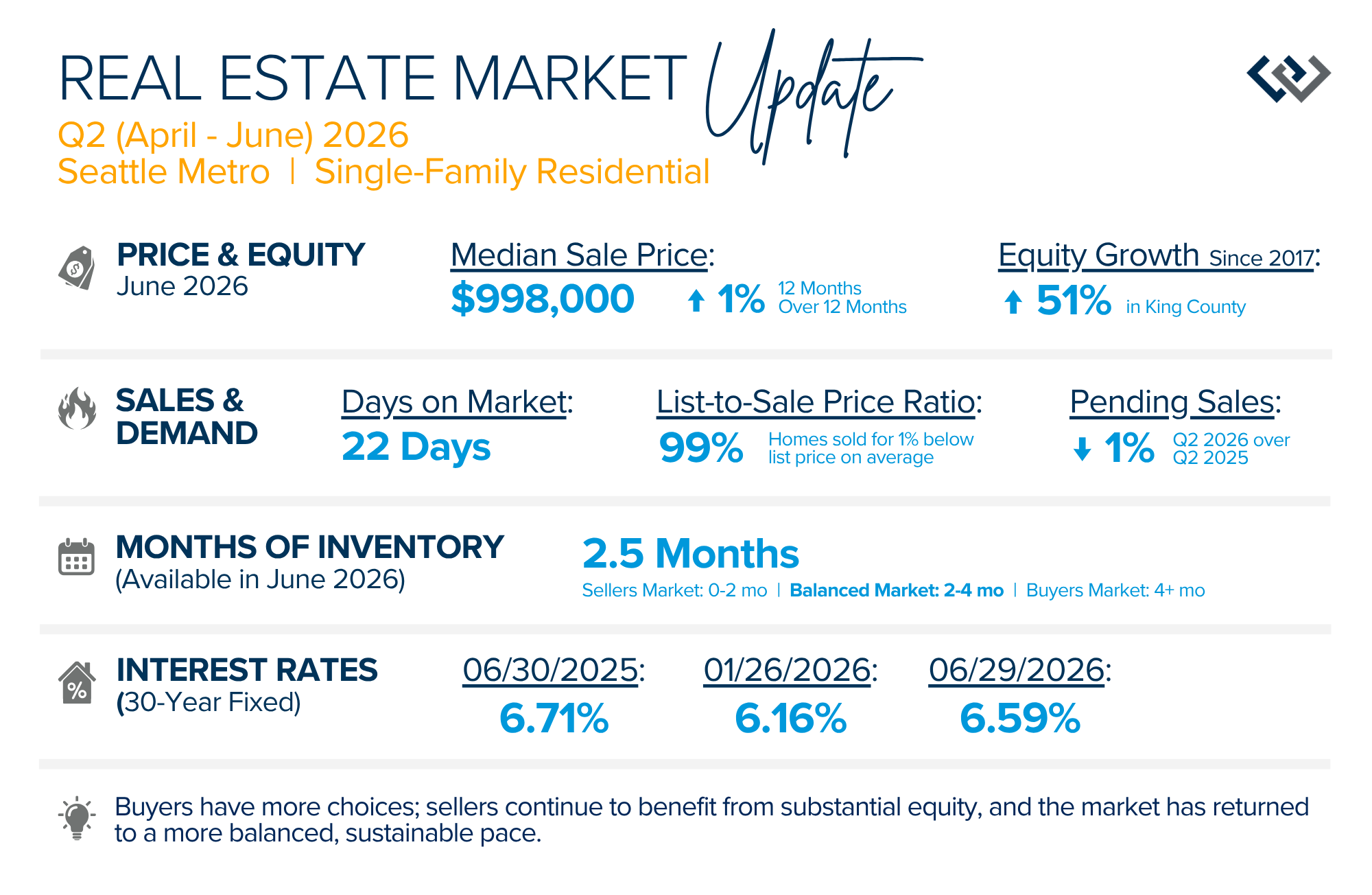
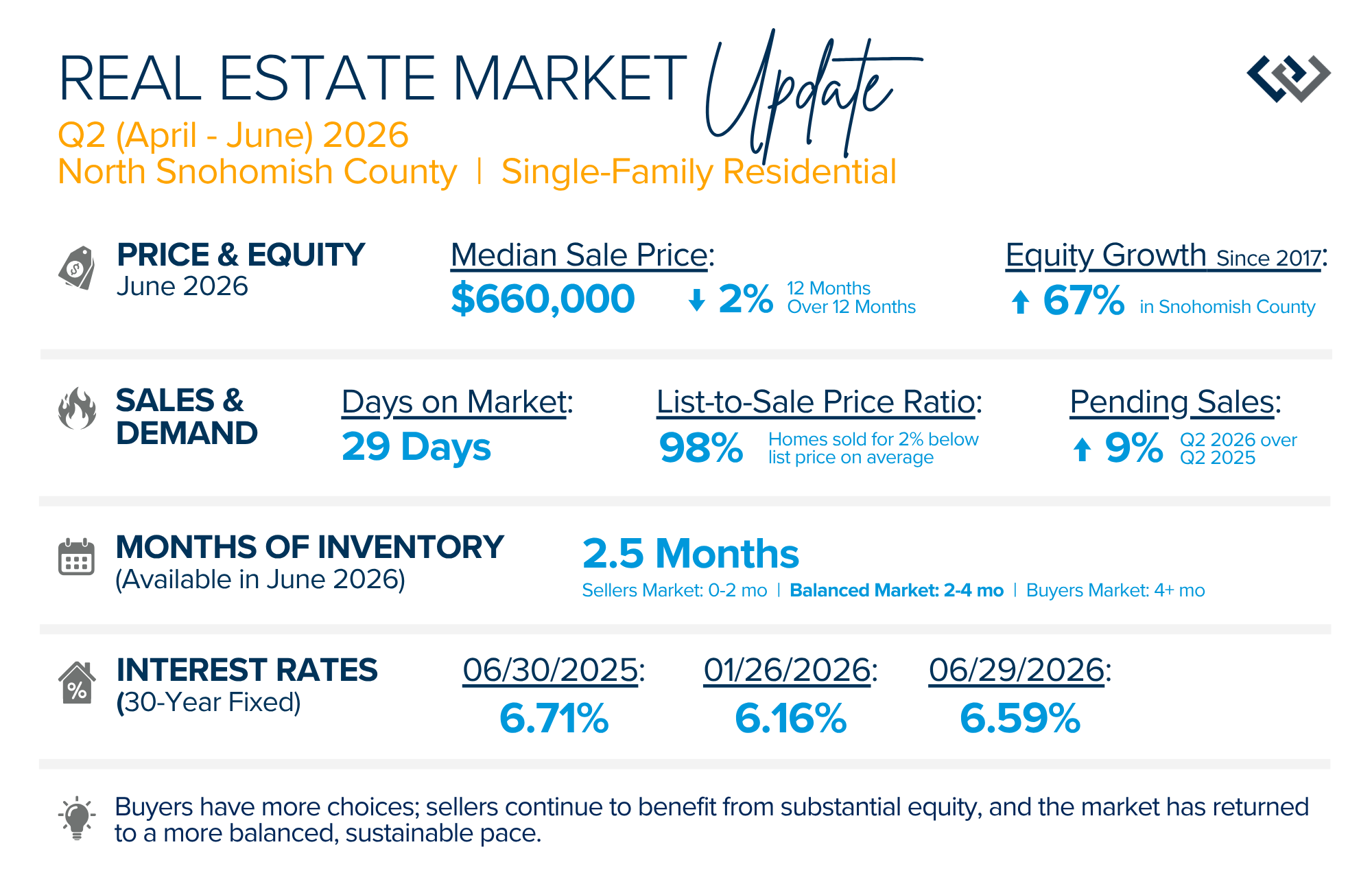
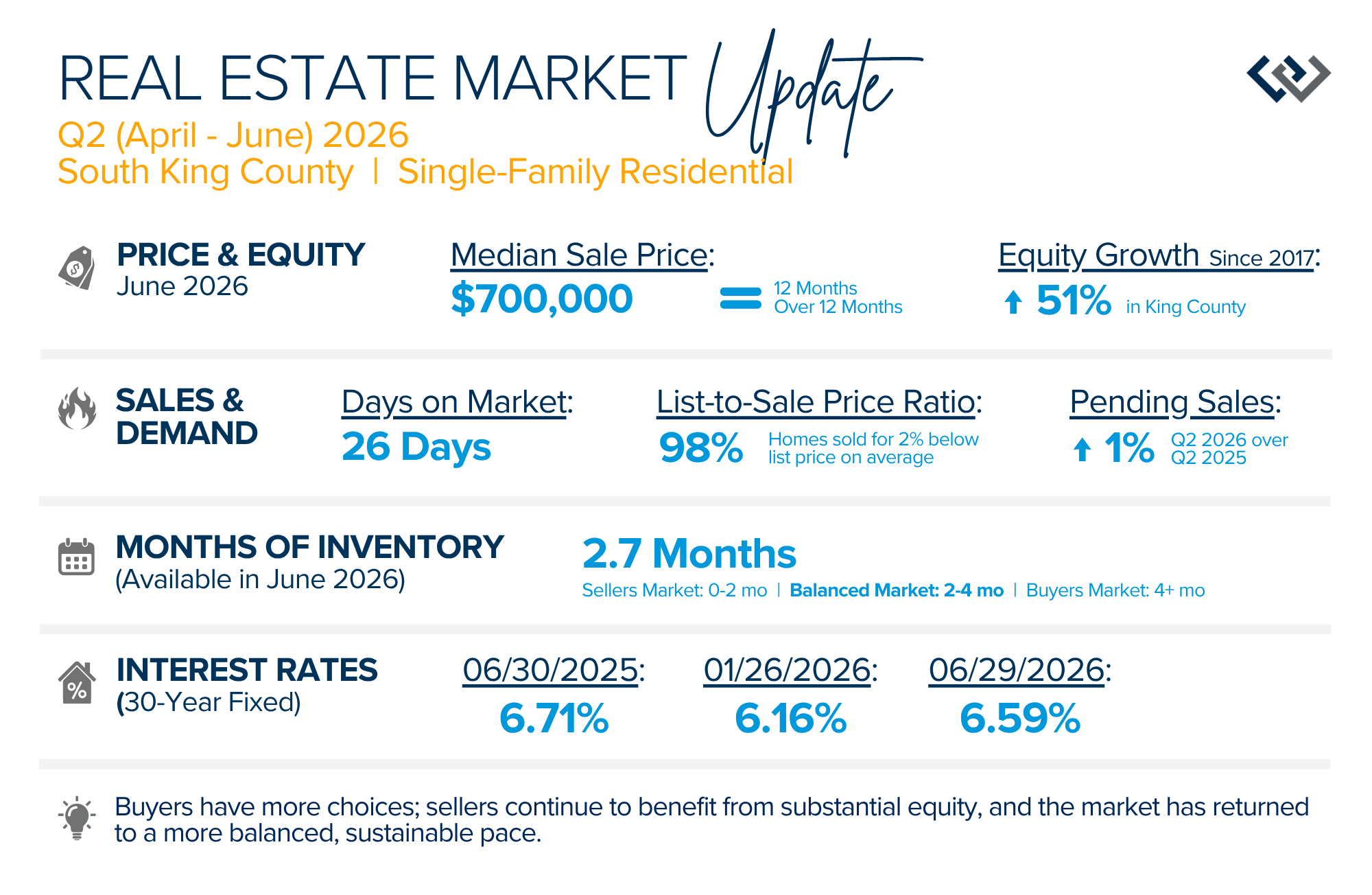
While home values have leveled off after years of remarkable appreciation, today’s market is healthier than many realize. Buyers have more choices; sellers continue to benefit from substantial equity, and the market has returned to a more balanced, sustainable pace. In fact, since 2017, the median home price has grown by 67% in Snohomish County and 51% in King County.
Real estate has always been a long-term investment, and today’s market continues to reward strategy over speed, not perfect timing. Whether you’re buying, selling, or simply planning ahead, understanding the data to gain perspective is key. Whether you’re curious about your home’s current value or considering a move in the future, I’m here to help keep you informed to empower strong decisions.
Seabrook, WA: Your Next Great Escape

Summer has arrived, and if you are looking for a great escape only 3 hours from Seattle, you should check out Seabrook on the Washington Coast! I had the opportunity to enjoy it this winter, and I am excited to share all the aspects this gem of a town has to offer, along with a discount you can use for your stay. This town can be enjoyed through all four seasons, but summer has to be amazing!
I can extend to you a 20% discount off your stay. Seabrook and Windermere  have partnered, and Windermere has become the official real estate company representing Seabrook. This partnership allows us to pass on this discount to our clients who would like to visit. If you are interested in receiving the discount, please reach out, and I can get you registered and personally connect you with the Seabrook rental team to ensure you get to enjoy this special offer.
Seabrook is a beach town along the Washington Coast’s Olympic Peninsula that is seamlessly woven into nature. The town sits on a scenic bluff overlooking the Pacific Ocean, offering incredible views and unmatched beach access. Seabrook is a thoughtfully-built new town founded on new urbanism design.
Seabrook features over 475+ Washington Coast homes in eight neighborhoods, some available as vacation rentals and some available for purchase, as well as numerous merchants, more than 30 parks, a Town Hall, and countless amenities. Seabrook is a walking and biking paradise! Designed with a “walk to anything in five minutes” principle in mind, guests and residents routinely comment on the thoughtful design their team has employed to create this unique vacation town.

Every year, thousands of guests stay at Seabrook by booking one of the over 270 homes in their popular Vacation Rentals program. No home is the same, accommodating anywhere from two to twenty people (dogs, too, in certain homes).
In addition to promenades and walking trails galore, you’ll find a central amphitheater, a hilltop and oceanfront park, outdoor games and playgrounds, a Town Hall, fire pits, horseshoe pits, mountain bike trails, a heated indoor pool, and spacious Crescent Park. Leave the car in park and explore simple living on the Washington Coast.
All of the homes come with well-appointed kitchens, but we all know that grabbing a bite to eat while on vacation is a bonus. Whether you’re looking for a romantic dinner, a family-friendly meal, or coffee before a beach walk, Seabrook offers dining options for every taste, all within an easy stroll of the town center.
- Frontager’s Pizza Co. – Wood-fired pizza, pasta, salads, local beer & wine.
- Koko’s Restaurant & Tequila Bar – Elevated Mexican cuisine, craft margaritas, weekend brunch.
- Rising Tide Tavern – Burgers, seafood, fish & chips, salads, and local brews.
- The Stowaway Wine Bar – Wine, charcuterie, and small plates in a cozy setting.
- Vista Bakeshop – Fresh pastries, breakfast sandwiches, artisan breads, and coffee.
- Bellwether Cafe – Espresso drinks, breakfast, sandwiches, and grab-and-go options.
- The Sweet Life – Ice cream, candy, fudge, and milkshakes.

SEABROOK AND THE ART OF TOWNMAKING
Town founders, Casey and Laura Roloff, first met in high school and quickly realized they had one major thing in common — they loved the beach! After graduating from college, they married and moved to the Oregon Coast, where they started their very first business painting houses.
As the Roloffs became more involved in the local community, they studied the local and national real estate markets and recognized an opportunity to build custom vacation homes, second homes, and primary residences that had architectural character and an uncommon attention to detail.
Using new urbanist design principles and inspiration from the internationally recognized town of Seaside, Florida, they set out to build their first beach community, Bella Beach, on the Oregon Coast. Finding great success with Bella, they eventually looked northward towards Washington State for a similar opportunity. This led them to Grays Harbor County, where, in 2004, along with their innovative design team, they worked collaboratively to curate and develop Washington’s most celebrated beach town, Seabrook.
A TOWN WITH A PEDESTRIAN-FRIENDLY SCALE
Visitors to Seabrook experience how the lost art of town making has been brought to life with a specialized design concept known as The New Urbanism. Everything in the coastal town is purpose-built with walkability and connectivity intertwined with the beautiful coastal surroundings, a signature of the Pacific Northwest.
Entering Seabrook is stepping into a welcoming, comfortable and charming atmosphere that has all been carefully planned and accomplished one home, retail space, amenity, or trail at a time. Yes, cars are welcome (how else are you going to get there?), but you’ll be happy to leave them stowed away in a carriage house or along one of the tree-lined streets where on-street parking is actually encouraged to ensure safe streets for pedestrians and bicyclists.

INTENTIONAL EASE OF ACCESS
The transect concept provides zones that are an important part of new urbanism planning and that help describe the wide range of community transitions from rural to urban with an emphasis of increasing town-wide accessibility to homes, shopping, and amenities.
Proximity To Metropolitan Areas
Seabrook is conveniently located a short drive away from Seattle and Portland, making it an accessible drive-to vacation location that has been on-the-rise for years. The beach town is also situated near popular sightseeing destinations like the Olympic National Park (a World Heritage Site), a 45-minute drive away.
Homes to Accommodate Everyone
Seabrook was built with inclusivity in mind. Homes of all sizes, from 2-person carriage homes to homes that sleep upwards of 20 people, create a sense of community for everyone living or staying in Seabrook.
Merchants & Town Events
In Seabrook, children play freely and safely, merchants quickly become staple stops of old and new patrons alike, and events bring the community together for conversation and memories made. They even have venues you can rent for your own special events such as a wedding.
Miles of Shoreline and Trails to Explore
But we can’t forget about the beach. All roads (or, in Seabrook’s case, walking trails) flow down to the magnificent allure of the Pacific Ocean. Seabrook’s three beach accesses provide a convenient way to enjoy and access the beach from its three oceanfront neighborhoods: NW Glen, Pacific Glen, & Elk Creek.
Community Involvement
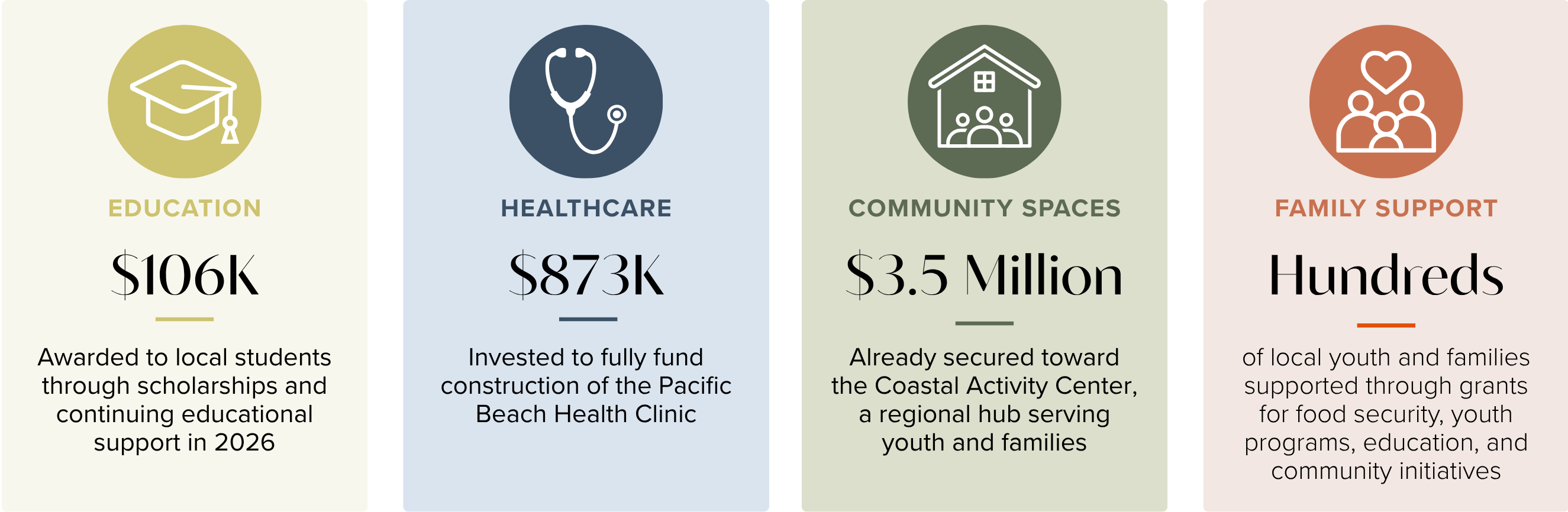
The connectivity also expands throughout the local community and county. The Seabrook Community Foundation awards grants to many Grays Harbor County Nonprofits with an emphasis on aiding Grays Harbor Youth. One percent of every house sale goes towards the efforts to uplift the North Beach community that surrounds Seabrook.
I highly encourage you if you have a blank space in your calendar this summer or any other time of the year to visit Seabrook. Its charm, connection to nature, and easy access from the city makes it a great place to invest your vacation dollars. If you are interested in exploring the real estate market there, please reach out. I have connections to the sales team now that they are a Windermere affiliate. Here’s to a beautiful summer ahead and finding some time to wind down with the people that matter most.

Design Trends for 2026 & Beyond: Softer, Lived-In Luxury
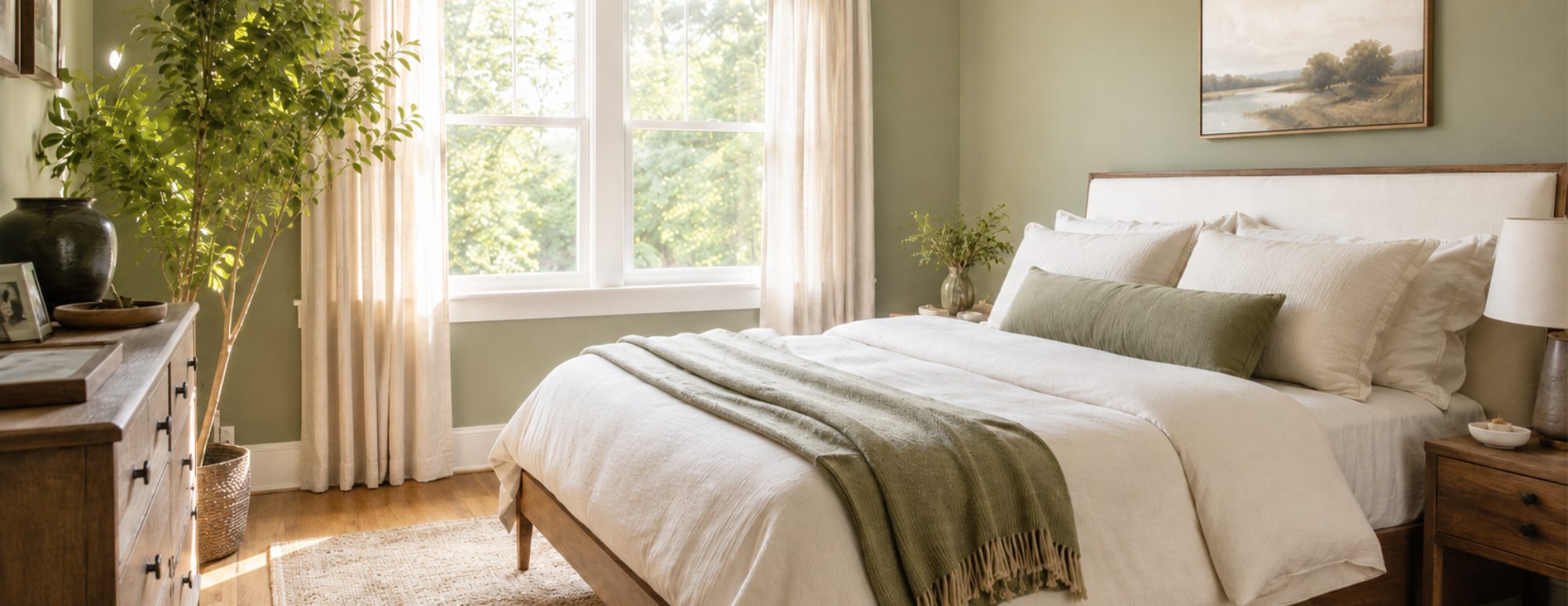
As we find ourselves in the midst of spring, freshening up our surroundings is a natural inclination. If you have been dreaming of updating your space, trying something new, or just want an overall refresh, I’ve uncovered the latest trends to help inspire your next project. Don’t miss all the fun links below that help bring these trends to life.
As a broker who is in and out of hundreds of homes a year, I can definitely say these simple pivots can add enjoyment plus resale value to your home. Many of these design trends can be done on your own or involve minor changes that make a big impact without breaking the bank. Some are more involved, but if you are considering a remodel, these great tips will help ensure your investment is on track.
The biggest home design trends for 2026 are all about warmth, texture, personality, and nature-inspired living. After years of ultra-minimal, gray-and-white interiors, designers are moving toward homes that feel layered, emotional, and timeless rather than overly “perfect.”
Here’s a breakdown of the top trends across paint, decor, surfaces, kitchens, baths, and landscaping.
- Paint Color Trends for 2026
Warm Earthy Neutrals Replace Cool Gray
Designers are calling these “grounding neutrals. The dominant palette for 2026 is:
- warm taupe
- mushroom
- khaki
- camel
- espresso brown
- clay and terracotta
- olive and eucalyptus greens
Most talked-about tones:
- Sherwin-Williams “Universal Khaki”
- Benjamin Moore “Silhouette” (deep espresso-charcoal)
- Valspar “Warm Eucalyptus”
- rich browns and muddy greens
Best Seattle-Friendly Paint Colors
These work especially well in cloudy PNW lighting:
- Benjamin Moore Swiss Coffee
- Benjamin Moore White Dove
- Benjamin Moore Pale Oak
- Benjamin Moore Edgecomb Gray
- Sherwin-Williams Alabaster
- Sherwin-Williams Accessible Beige
- Sherwin-Williams Drift of Mist
- Sherwin-Williams Greek Villa
- Sherwin-Williams Shoji White
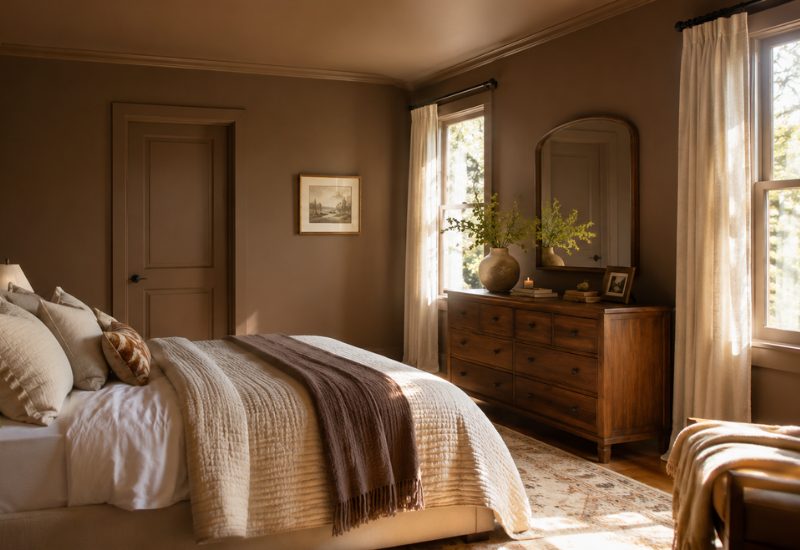
Color Drenching Continues
Color drenching, which involves rooms painted in a single tone, including walls, ceilings, trim, and cabinetry, is still trending strongly in 2026. This creates a cocoon-like, luxurious feel. Popular drenched colors:
Soft Pastels Are Back, But Sophisticated
Soft pastels are being used in a more grown-up, vintage-inspired way rather than in a playful or childish way. Popular colors that add warmth and softness are:
- Interior Decor Trends
“Lived-In Luxury”
Lived-in Luxury is a design style that makes a home feel elevated, beautiful, and curated, but also comfortable, warm, personal, and actually livable. The aesthetic is cozy sophistication instead of sterile minimalism. Homes are becoming:
- softer
- more personal
- less staged
- more collected over time
Expect:
- antiques mixed with modern
- handmade pottery
- layered textiles
- books everywhere
- artisan lighting
- vintage rugs

Curves & Organic Shapes
Sharp modern edges are softening. The aesthetic in 2026 includes:
Statement Lighting as Art
Lighting is now treated like jewelry for the room rather than a utility. I’ve been impressed with lighting options that are not overly expensive, and the impact that is made is huge. Simply replacing a “boob” light in a bedroom with something more elevated or a bar light above a bathroom mirror that has more appeal can change the feel of the entire room and elevate it. Lighting is becoming sculptural:
Chrome Is Back
Warm brass still exists, but polished chrome and nickel are returning in a cleaner, more timeless way. I am also seeing a trend of mixed metals rise to the top. Along with the layered, more collected look, having a balanced variety instead of just one tone throughout creates a cozier, more interesting space.
Especially trending in:
- kitchens
- baths
- cabinet hardware
- faucets
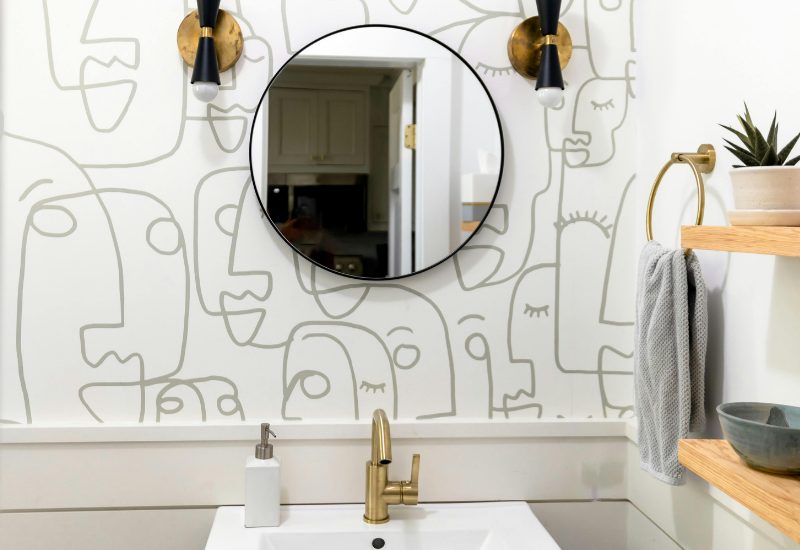
Wallpaper is no longer just “pattern.”
Wallpaper is having a MASSIVE moment in 2026, but it looks very different from the wallpaper trends people remember from the 1990s or even the accent-wall era of the 2010s. The biggest shift is that it’s becoming immersive, tactile, and soulful. Expect:
- texture
- atmosphere
- architecture
- storytelling
- emotional design
- Hard Surface Trends
Natural Stone with Movement
While new paint, switching out hardware, and updating lighting can be somewhat easy and less costly, new hard surfaces are a bigger investment. If you are considering replacing your countertops, choosing dramatic natural stone instead of plain quartz is the direction we are seeing designers go. The more movement and organic texture, the better. Even a quartz with some veins has been popular versus something more plain.
Trending:
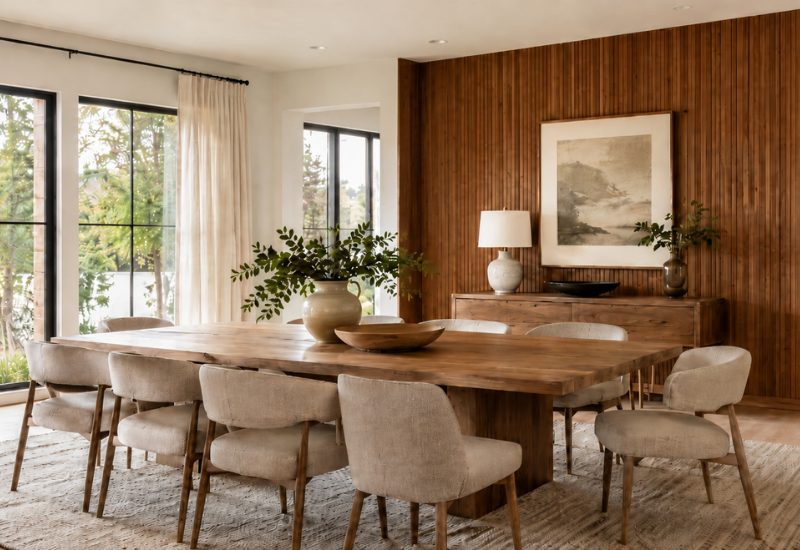
Warm Woods Dominate
White oak remains huge, but darker woods are rising:
- walnut
- smoked oak
- medium brown woods
- rich paneling
Warm wood paneling is especially trending in mid-century modern homes and recently-built modern new construction homes. Gone are the days when wood paneling is frowned upon. I’m even seeing older homes that still have original wood paneling be preserved and highlighted. There are really fun wood paneling kits that are available to do an accent wall, stairwell, or end of a hallway to add depth, texture, and warmth.
Textured Finishes
Flat, sterile finishes are fading, and imperfection is now considered luxurious. This aligns with the more curated, collected feel that lends itself to coziness and evokes emotion.
Trending textures:
- limewash walls
- Venetian plaster
- fluted wood
- Zellige tile
- handmade ceramic tile
- textured stone
Tile Trends
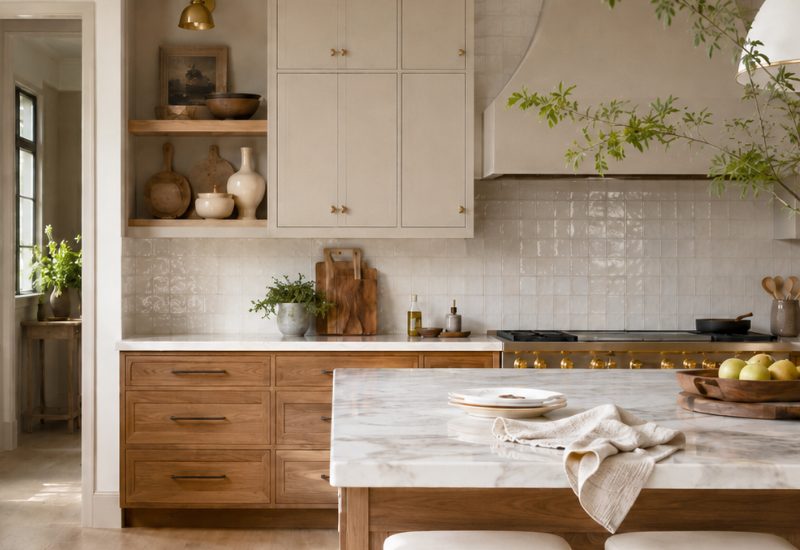
Personalized tilework is becoming a major design feature. Tiles with texture, warmth, and variation can make a room feel softer and less stark. Zellige tile, which is intentionally irregular (has differing tile height and imperfect edges), glossy, and reflects light, can be found in whites and creams or in tonal shades, which are big in 2026:
- checkerboard stone
- mosaic tile
- slab backsplashes
- handmade-look tile
- full-height stone walls
- Kitchen Trends
“Soft Kitchens”
Kitchens are becoming warmer and less clinical. Completely white modern kitchens are being replaced with warmer, layered kitchens. Creams and wood are highlights to create dimension, character, and warmth.
Trending:
- wood cabinetry
- creamy paint colors
- hidden appliances
- furniture-style islands
- mixed materials
Mixed Cabinet Colors
Instead of one uniform kitchen look, updates are added to create a very custom-looking space with mixed cabinet colors. As I mentioned above, a mix of hardware and paint can help bring a space to life and add character and charm. This should be done in a well-balanced way to provide a consistent, curated feel.
Integrated Wellness Features
The home is becoming more wellness-centered. Creating spaces to slow down, simplify, and center in health are increasingly popular. Favorite wellness features for kitchens include:
- beverage stations
- hidden pantries
- indoor herb gardens
- filtered water systems
- calming breakfast nooks

- Bathroom Trends
Spa-Like Natural Bathrooms
Bathrooms are becoming retreat spaces and feel more spa-like versus utilitarian. Huge movement toward softening the space by using:
- warm stone
- soft lighting
- plaster finishes
- natural wood vanities
- wet rooms
- freestanding tubs
Statement Stone Slabs
Large slab walls and dramatic stone vanities are replacing busy tile patterns.
Especially popular:
- travertine
- marble-look quartzite
- green-veined stone
- Exterior & Landscaping Trends
Nature-Inspired Exteriors
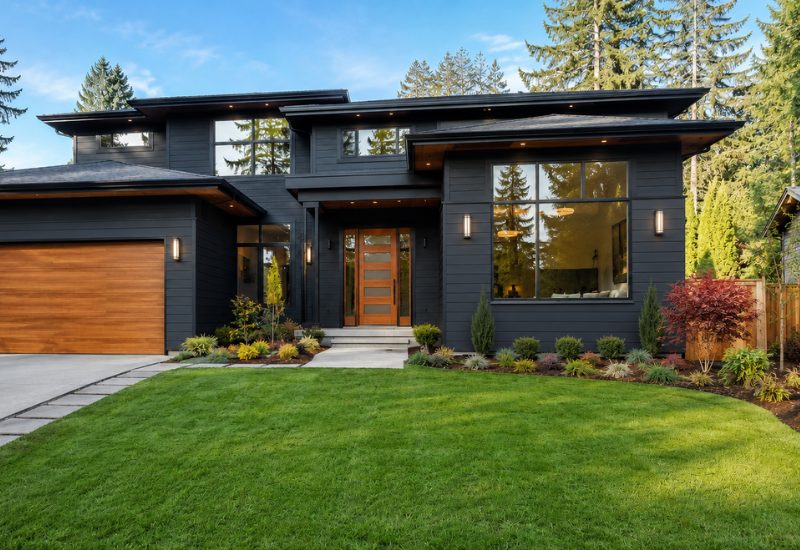
Exterior palettes are becoming softer, earthier, and more architectural. This is probably the question I am most often asked, “what color should I paint my house?”. Darker exterior colors have been on the rise for some time, and they continue to stay there, but with a bend towards earth tones such as sage green, olive green, warm white, mushroom brown, and charcoal brown.
Trending colors:
- Sherwin-Williams Evergreen Fog
- Sherwin-Williams Pewter Green
- Benjamin Moore White Dove
- Benjamin Moore Pale Oak
- Sherwin-Williams Urbane Bronze
Landscaping Becomes More Organic
The “perfect manicured yard” is fading and leaning towards more organic landscapes. People want landscaping that feels connected to nature and has lower maintenance.
Trending:
- native plants
- meadow-style gardens
- layered greenery
- drought-tolerant landscaping
- edible gardens
- natural stone paths
Outdoor Living Rooms
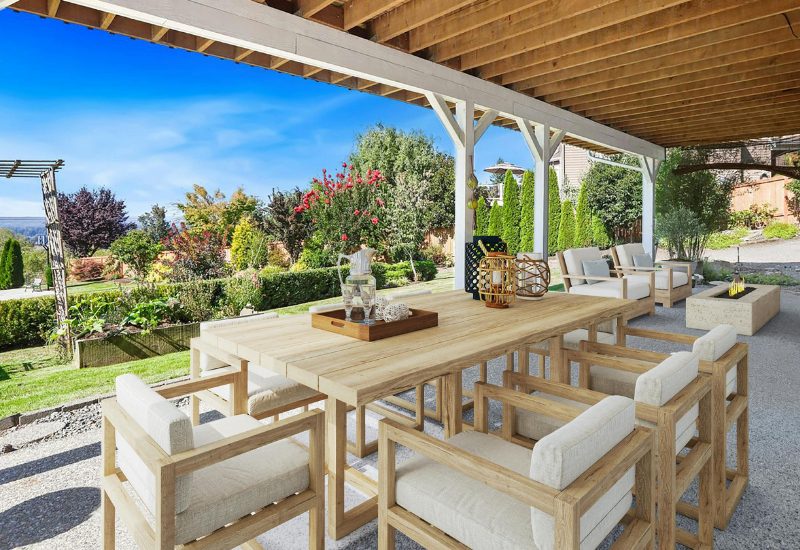
Backyards are increasingly designed like interior spaces. Indoor-outdoor living was a big trend that was identified during Covid and stuck. It is still growing strongly, and a feature that creates expanded enjoyment and a great ROI when selling.
- outdoor kitchens
- lounge furniture
- fire pits
- pergolas
- textured lighting
- integrated dining spaces
The Overall 2026 Aesthetic
The big shift is from cold minimalism, gray everything, and ultra-modern perfection to warmth and layered texture that evoke emotional comfort by using nature-inspired materials, individuality, and timelessness. Designers are calling it organic modern, lived-in luxury, earthy vibrancy, and modern heritage. I hope this overview of the latest 2026 design trends has created some inspiration, whether you’re looking to make some minor, impactful tweaks or to embark on a remodel. Please reach out if you need access to some trusted vendors who can help you bring your vision to life.
